Lichens Seen On Hike


Lichens Seen On Hike
This will be the first Christmas since my brother died.
It was difficult for my family to gather together for the holidays. I lived in New Jersey, Washington, and California. My brother lived in Michigan, Utah, Texas, and Nevada. My sister lived in Maryland and South Carolina. Making our way home to Ohio at the same time was challenging.
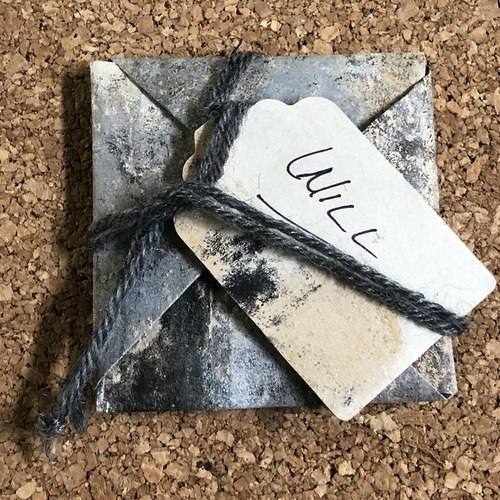
The last time we were all together, my brother was constantly singing the song, Let It Snow always emphasizing the word, frightful. Since all of my family is now lost, I decided to make a little card for myself as a memento of that last Christmas.

The stitched lines are code for, let it snow.
I had considered printing out the sheet music, but my brother never sang the whole song. This seemed fitting.

After the sudden death of my brother in July, I was having a difficult time dealing with the loss. My brother had a strong faith and believed that after death he would be reunited with his son.
I used the notion of reunited to make the wallpiece. The piece has the first names, dates of birth, and dates of death in code.


Tomorrow is the anniversary of my nephew’s death. He died 35 years ago at the age of 17. I had the idea of making a vessel, but how? Serendipitous that someone I follow on YouTube recently posted a fun video on making pots out of embroidery.
The channel is Sarah Homfray Embroidery. I like that she is creative, lovely, and delightful.
I used the same rusty fabric that I used in the wallpiece. The blue thread is Rick’s name. The brown thread are dates for birth and death. The tan thread is for 2025, and to stitch the piece together.


I used Fabric-Tac to adhere the folded fabric of the vessel, to make it sturdier, and to make it easier to stitch. After making the vessel, I wrapped a glass in plastic and slid the vessel onto the glass. Applied matte medium to the exterior of the vessel to basically hold everything in place–the stitched code and the frayed edges of the rusty fabric.
The finished piece is 5″ in height and 3″ in diameter.


The quote used is by Niall Williams.

Cover Code is Modified Morse–Our Stories

Pages 1-3

Pages 4-6

Work in Progress
The code was stitched in wire; then oxidized.

Back Side Of Page 1

Page 1 Wire Removed

Completed Page 1 Attached with Safety Pins

The Code Layout
Pages 1 and 2

Pages 3 and 4

Pages 5 and 6

Notes During Process–
I have used the same oxidizing solution for years. Something interesting and unexpected happened when I was working on the pages for this piece. Rather than the typical rust color, this happened–

Never had a purple result. Curious why. I suspect it was because there was a chemical reaction between the salt (iodized) and the peroxide. I did some quick tests–salt and water on watercolor paper, salt and isopropyl alcohol on watercolor paper, and salt with peroxide on watercolor paper. Purple occurred with the salt and peroxide. Was the purple color not because of salt and peroxide but perhaps the watercolor paper binder? I tested the same three combinations on printer paper and drawing paper. Purple color occurred on all of the tests with peroxide and salt (iodized).
Even more curious; after the pages were dried in the sun, the purple color vanished. Brought to mind, the purple school glue that dries clear.
Still did not have the result I wanted, so I mixed up the oxidizing solution with sea salt. The result is the pages in the book.
Materials–Oxidized Canvas and watercolor paper, safety pins, fiber, paint, metal bead, wire for oxidation, oxidizing solution.
Scale–Closed: 5.5″ x 4.75″ x 1.25″ Open: 5.5″ x 26″ x .25″
Cover Affixed to Book and Drying.


Modified Tap Code–Truth

Metal and Loom Knit Closure

Back of Book

Lined with Mulberry Paper

Modified Morse Code Used, Layered Vertically and Horizontally

Each Block is a Letter, Stitched onto Cardstock Lined with Rice Paper.

Page One–Truth

Blocks were Stitched onto the Book Pages. The Thread Was Run Horizontally Through the Corrugated Cardboard and Then Through the Page and Knotted.

Page Two and Three–Is Not


Page Four and Five-Negotiable

Letterlocked Notes on Work


In 2018 on May 15th, my mother died. Every year I make a piece to remember my mother and her life.

The beads are from one of my mother’s necklaces.

Code for the word–Loss

Inside of the piece.

It can be free standing.

Code for my mother’s date of birth 02151930 and the date of her death 05152018.

The code for this page is 2025 and Unshed Tears for My Mother.

I knotted the green thread around the raw white linen. Each five knots is used to represent a dash. There are two dashes (M), space, three dashes (O), space, and two dashes (M).

Materials–
The green paper is painters’ paper. I had some paint left over from a piece. Rather than letting it go to waste, I printed it on a roll of paper. I used a parcel for the corrugated cardboard. The remaining materials are–watercolor paper, a few metal bits for the closure, beads from one of my mother’s necklace, and adhesive.
Scale–5.75″ x 4.75″ x .5″
Vicia sativa


Tragopogon porrifolius


One of my favorite plants, not a weed–
Hibiscus trionum

The harvested seed was from several years ago. A pleasant surprise.
It is challenging to show the complete content of art books.
If the book is closed the content on the pages is concealed. If the book is open, the closure, cover, and remaining pages are not accessible.
Today I was watching a video on YouTube–
8 Japanese Aesthetics That Might Change How You See Beauty
I was struck by this passage–
Masayuki Kurokawa (Japanese architect and designer) explains that hiding part of a work is not about withholding. It’s an invitation.
The creator doesn’t expect the viewer to see the work exactly as they do. Instead, they hope the viewer will bring their own thoughts, feelings, and experiences, and in doing so, become part of the creative process. In this way, Japanese aesthetics do not always aim for precise communication.
There is no single correct interpretation.
Instead, there’s a quiet belief that something in the viewer’s heart will naturally resonate with the creator’s intention.
Art becomes complete through that shared experience, through presence, imagination, and mutual sensitivity.
I agree with the bit about the viewer bringing their own thoughts… I generally think of it as seeing the work through the filter of your own experiences.
I don’t agree that the viewer becomes part of the creative process, just by looking at the work. I feel that devalues the artist’s education, years of experience, the number of works constructed, and the work.
My interpretation is the correct one for my work. If someone views my work and arrives at a different interpretation; their interpretation is not equivalent to mine. Their interpretation is not valid.
For example, a viewer may appreciate a material used in one of my pieces but may not comprehend the importance of that material to the content. How can they possibly arrive at a valid interpretation of the work?