Rust Dyeing and Stained by the Past

Last night I was reading through a few blogs that I subscribe to, and ran across reference to rust dyeing. I snagged loads of oxidized bits from my Dad’s shop that might work nicely.
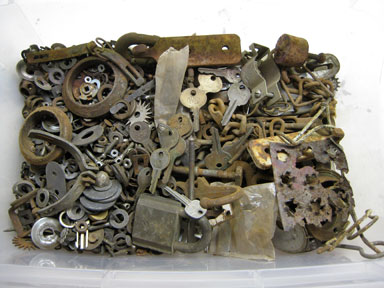
metal bits

Of course I would want to place the items so the images left behind make coded messages.

It is interesting that the techniques mentioned are not all that different from some techniques used to apply patina to metal. One site suggested placing the wet fabric wrapped around metal in a plastic bag. Sounds a bit like fuming to me.

I wonder why I hadn’t thought of using patination techniques as a transfer method. I have rusted metal bits that remained in pieces. They were either rusted first or after they were bound into the piece.
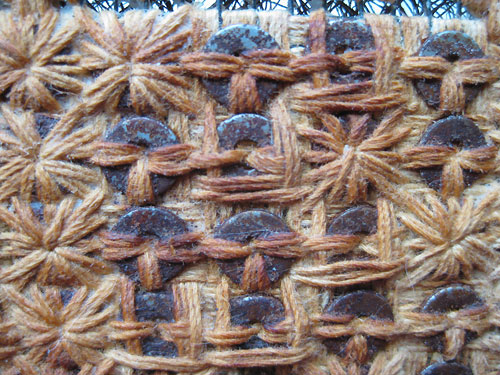
Stained Detail

Detail of a work in progress–Stained by the Past


A few highlights of what I found–

Vinegar is used straight or as a 50/50 with water, bath or in a mist bottle

Contact time can be a day to 5 days. Variables would include the color and type of the fabric used, and the type of rust applied, amount of saturation of fabric. Misted fabric would dry quicker than fabric that has been saturated and placed in a plastic bag or container to keep fabric damp.

Neutralizing the rust process requires saturating the rusted on fabric with a saline solution, and a washing. The saline solution can be as weak as 1 tablespoon to a gallon of water.

On The Natural Dye Notebook I found a technique for making a rust solution that can be applied with a brush to fabric.

Mix a small amount natural rust with water, I generally use one teaspoon rust to one cup liquid, or with soy milk…

Green Willow Studio

Artstitches

Hobbyfarms.com


The Comfort of Books–A Three Dog Life

Today while I was working on a database I listened to one of the University of Minnesota Bookstore Author Events. It was a talk and reading by Abigail Thomas. The reading was from A Three Dog Life.

The book recounts Abigail’s experience as the spouse of an individual who sustained a traumatic brain injury. It is written with such honesty and humor, I felt like I was sitting with a friend having a discussion over coffee. Or in my case a cup of chocolate.

After listening to Abigail, I ordered a copy for my Mom. The last few years of my Dad’s life were a challenge for her. He had several surgeries, some dementia, and spent his last months in an extended care facility. It occurred to me that Abigail’s journey and words might be of some help to Mom during her grieving process.

This is a photo of my copy of A Three Dog Life. Can you tell how much I loved the book?

A Three Dog Life

Some of the pages are folded at top and bottom, and on both sides. And there are underlined passages as well.


These are a few of my favorite passages–

The past gets swallowed up in the extraordinary circumstances of now. p16

Rich spoke in mysteries. It was as if he were now connected to some vast reservoir of wisdom, available only to those whose brains have been altered, a reservoir unencumbered by personality, quirks, history, habits… p17

I can’t find the place that matches my memory. p27

Dogs are never in a bad mood over something you said at breakfast. Dogs never sniff at the husks of old conversations… p75

I kept forgetting the fact that I actually couldn’t take care of him. My terror obscured the truth: no single person, no two people could have taken care of a man in Rich’s condition. Why then did I feel so ashamed? What standard do we women hold ourselves to? After all these years I can finally say the words I want to live my life without feeling unnatural, selfish, cowardly. p115


I’m employed by a software company that produces projects for “language, learning, and speech,” which includes projects for TBI. My interest in brain injury began when my nephew suffered an injury when he was 18 months old. I had seriously considered a career in art therapy, but after researching it three times during various stages of my life I realized it wasn’t a good fit for me. Art should be used for expression not as a diagnostic tool.


Penny, Penny…

There is progress, but it is taking so long to complete the project. I haven’t had loads of time for studio work. I was away because of family stuff and I have been working on several app projects. Can only manage a couple of studio hours in the evening.

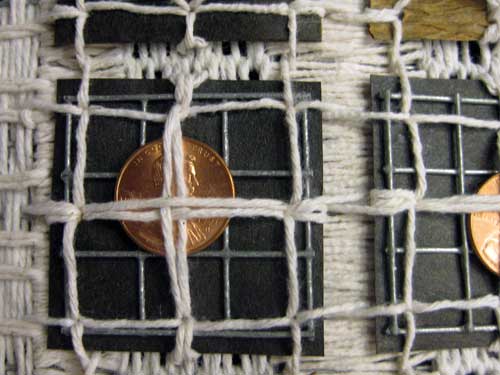
The blocks are tacked in place and now I am stitching them onto the background. Pretty sure that I will not be happy with the stitching until it is more substantial. Perhaps a knot at every hole–3 on each side, would mean 12 knots for each of the 252 blocks or 3,024 knots.

Binding

I haven’t yet decided how I will “age” the piece. Currently leaning toward wax with heat or flame. I do love to torch things. I will need to make some test pieces to see how the materials behave.

There is also the possibility of using asphaltum, which is somewhat consistent with roofing felt and tree wrap. In the past when I used asphaltum I willy-nilly mixed it with shellac and applied it with a brush.

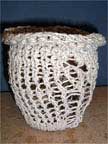
Or sugar. Sugar has been used as a stiffener for crochet work. I gave it a go several years back. Made a cotton open weave vessel.

Sugar Stiffener

6″ x 5.5″ x 6″
1 part water with 2 parts Sugar (I used a raw sugar so it did change the color of the cord)
Heated to dissolve, but didn’t boil. This takes a little time.

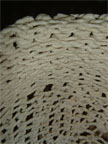
Sugar Stiffener Detail

I left the hot sugar in the pot and tossed in the piece to saturate the cord.
Blocked it over a jar covered with foil and placed a piece of plastic under. This is pretty drippy stuff.

The vessel has maintained its form, and has not attracted ants.


See a Penny Blocks Attached…

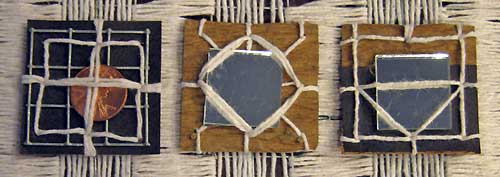
The blocks have been tacked on. Need to let the piece rest. Then a check to make sure the code is correct
Blocks Attached

I noticed that a couple of the blocks representing dots have the binding vertical rather than horizontal.
Detail
Will need to correct that. It is important that the texture of the tree wrap and binding be horizontal for proper alignment with the blocks representing dashes and spacers.


Memorial Bracelet

My Dad died.

It wasn’t unexpected, yet you never know how you will feel until something is reality.

The night before I flew home for his graveside service I made a memorial bracelet.

I cut a small piece of bamboo, drilled holes in it with my Dad’s old Black and Decker drill, then made some knots.

The pattern of knots on one side represents his date of birth, the other side the date of his death. Years back I read that bamboo has a cultural myth–mourning the death of a father.

Seemed appropriate, understated, personal.

Memorial Bracelet

The morning of his service I took cuttings from his garden to make a spray for his coffin.

At the service I didn’t feel as much of a loss as I did when I spent time in his shop knowing he would never be back.

When I went through his file cabinet I found the English-French Dictionary he used when he was stationed in France during the Korean War. A newspaper clipping was tucked inside. I believe that my need to keep mementos just might have came from my Dad.

Clipping

I also found letters I had written to him. He even kept the packet of photos describing an investment casting.

Bronze Process

Dad wasn’t one to say how much he cared, his actions showed it.


See A Penny Continued Again…

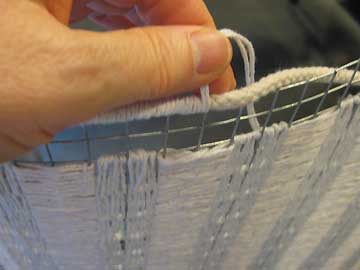
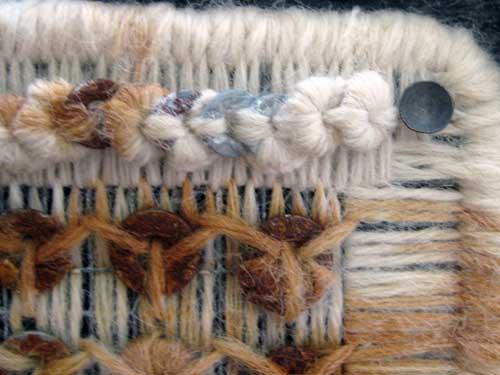
The edge of hardware cloth can be sharp enough to wound. Bound on a rope to act as an edging.

See Penny Edge.jpg

Then filled in the border with a couple of stitches.

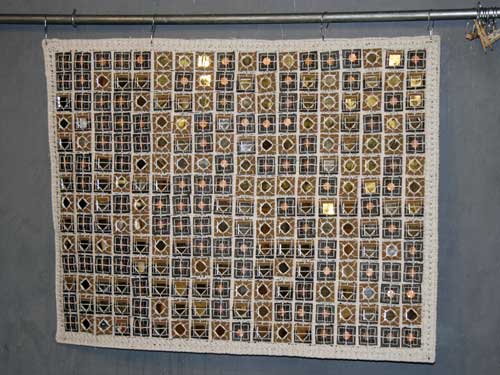
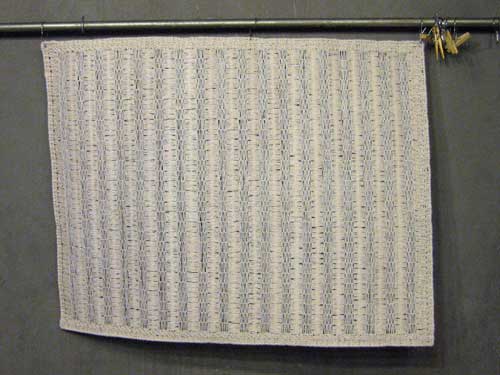
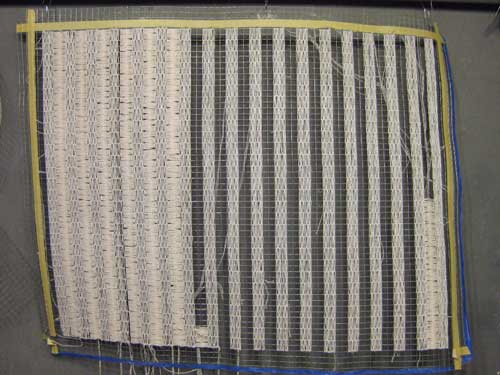
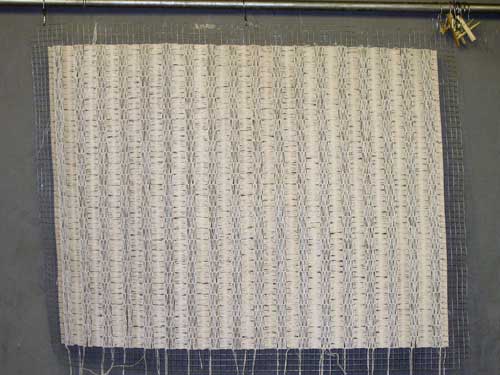
Completed_Background

Completed Background

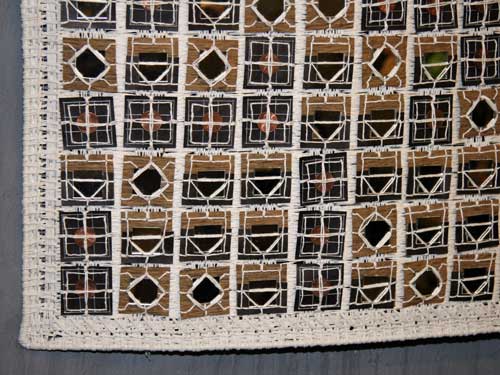
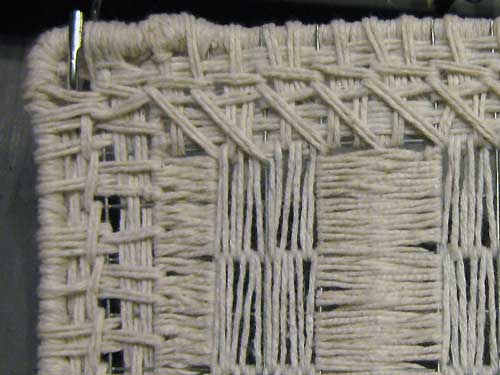
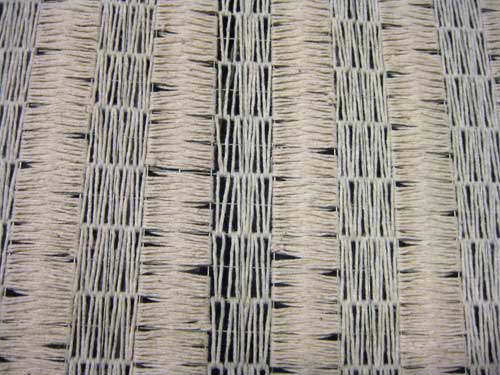
Completed_Background_Detail

Detail of Completed Background

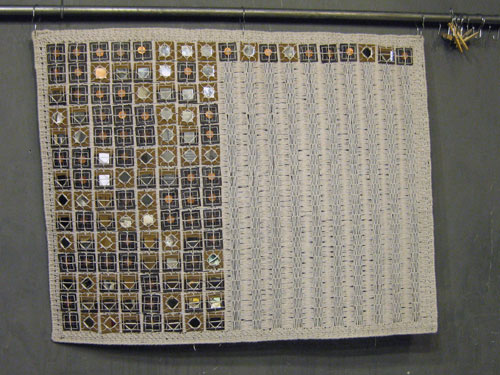
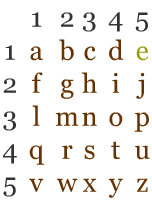
I am considering binding pennies onto the border with a message in Tap code. In Tap code the letters of the alphabet are laid out in a 5×5 grid.

Tap Code Grid

The code for E is 1,5. The code for the letter K is the same as the letter C.

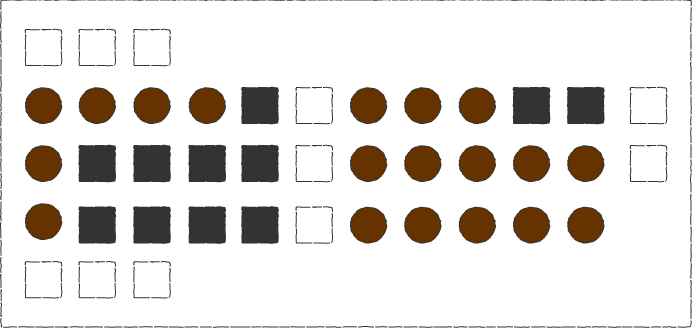
Often when I refer to Tap code I actually use a grid of 11, 5 spaces for the row and 5 spaces for the column with a space between. I fill in the empty spaces with a filler component; and add three spacers at the start of words, in between words, and at the end of words. This is a quick example of how I start laying out text in code–

See in Tap Code

The word see in my altered version of Tap code.

I am pretty sure that I am going to give the background an application of liquid starch before binding the blocks to it. The starch will prevent fraying and any knots from coming undone. Usually the “fabric” will feel quite like canvas.

Or I might decide to age the hardware cloth which will alter the appearance of the fiber. The appearance of weeping stain might occur.

Stained

An example of oxidized metal that stained the fiber.


See A Penny Continued Sunday Morning…

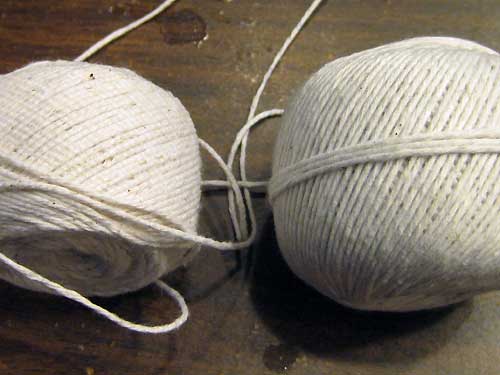
Pea Twine

This is why it is important to purchase more than enough twine for a project.
When you return to the store to buy more it may not be the same color.

Pea Twine Stitches

Since I am filling the background with two stitches, it made for an easy decision to make
the horizontal stitches one color and the vertical stitches the other color.

Background Sunday Morning

Background Sunday Morning

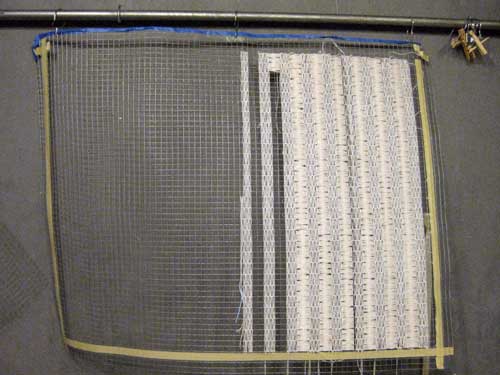
Blocks on Background

Blocks on Background
The blocks will be bound to the background and then stitched together to give the appearance that the stitching is holding them together. The tree wrap and roofing felt are not materials strong enough to support the weight of the piece. I’m pretty sure that I will use liquid starch on the background before attaching the blocks. Liquid starch is great for stiffening, to keep knots in place, and to prevent fraying. Haven’t yet decided how I will age the piece. Since I am using cotton I can use wax and fire.


Cutting Hardware Cloth

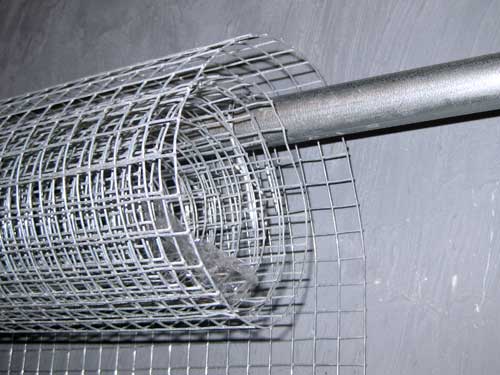
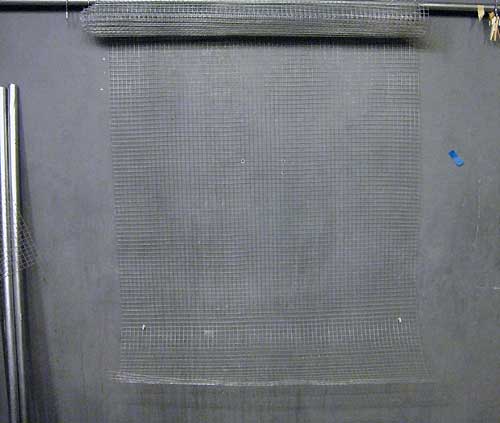
Today I opened a fresh roll of hardware cloth. It is springy and the edges sharp. Rather than standing on it and rolling it out on the floor, I slung it over the rod in my studio. Then I ran the hardware cloth behind the rod and fed it through.

Hardware Cloth

Hardware Cloth

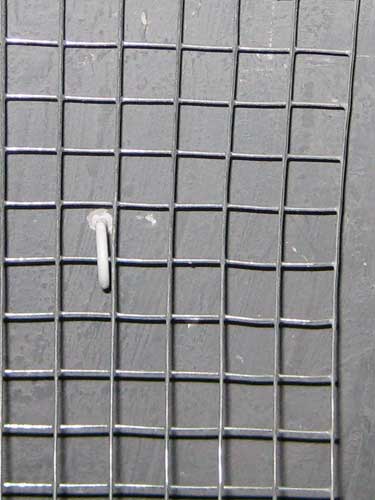
I was able to unroll and straighten at the same time. The piece of blue tape was for marking my place to cut. To prevent the hardware cloth from springing about while I was cutting it, I inserted a couple of cup hooks in the wall.

Hardware Cloth Cup Holders


Sometimes something simple and unexpected happens to make work a bit easier.