Is it Toxic?

I often use dried plant parts in my work. Typically the plants must have some interesting tactile quality, be toxic, and have a cultural myth or superstition. I was looking through a stash of dried plant parts and found some Haworthia limifolia leaves. They have great texture with sharp and pointy tips.
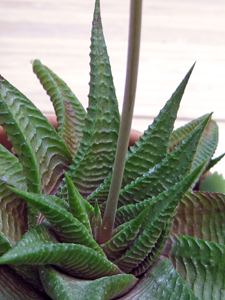
Haworthia

I googled Haworthia limifolia looking for information. I was a bit disappointed that the plant isn’t toxic. Apparently it is often used in place of Aloe for skin ailments. I did find a line that popped up in several articles, “Haworthia limifolia is often used by traditional healers as a spiritual remedy to ward off evil.” Curious. What kind of evil?

I have a contact at the UC Botanical Garden so I sent him an email inquiry about the plant. The plant is one that he gave to me several years back. He sent me a pdf of an article that I hadn’t read, Lightning Birds and Thunder Trees authored by Adrian Koopman. The article states that Haworthia is used as a charm to protect against lightning.

We don’t see much in the way of lightning where I live. Before reading about the plant’s reference to lightning, I had already bound the bits to a piece of hardware cloth to become part of a lid. My work must have the appearance of a life lived, so I age the work using one or more techniques–wax, heat, fire, salt, molten sugar, chemicals… and sometimes I bury the work.
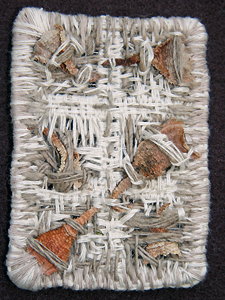
Haworthia for Lid

The Haworthia bits are bound to the hardware cloth with cotton and bamboo fiber which works great with all of the techniques.


A few lightning information links–

S.A. Weather and Disaster Information Service, South Africa

Global Hydrology and Climate Center

StruckbyLightning.org

Mortality Statistics–Victim of lightning by country

NOAA National Severe Storms Laboratory

Next Stop Wonderland and Books

I am addicted to Netflix streaming. Recently I listened to Next Stop Wonderland a film I viewed several years ago. I remembered liking the film for the dialog and the Bossa Nova sound track.

The dialog has some interesting notions–

“quietness without loneliness”

“contemplate something beautiful”

“…it’s important to have some daily ritual in your life that gives it a sense of consistency.”

Reading has always been an important part of my life. I like to start the day reading something to set my day. At the close of the day I enjoy reading something as well.

One of my favorite scenes in Next Stop Wonderland occurs in a bookshop. Erin, the central character, drops a book; it falls to the floor open and face down. She picks it up and is about to close it when the book seller says,

“Don’t close it. You should never close a book until you’ve read something from it… just a sentence or a word, it can be very, very revealing…”

I love books–reading them, thinking about them, the way they feel in my hands, the way they smell. When I was young I was taught to respect books. The book should not appear to have been read. Then something happened. First I started dog-earing the top of the pages to mark text in the upper half and the bottom of the pages for text in the bottom half. Then a double fold made if the text I wanted to remember was on both sides of a page.

Now I use books somewhat like a sketchbook. The books that I like quite a lot have dog-eared pages, highlighting, and underlining. And then there is my obsessive note taking, jotting down ideas, and making sketches in the white space.

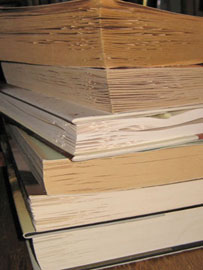
Stack of Books

This is a small stack of books that I liked very much when I first read them and when I reread them. Actually I liked them so much, I gave them as gifts. The stack includes work by Joe Coomer, Percival Everett, Brian Morton, Abigail Thomas, Margaret Atwood, and Richard Preston.

Pocketful
Joe Coomer
Pocketful of Names

Erasure
Percival Everett
Erasure

Evening
Brian Morton
Starting Out in the Evening


When I was preparing the links I realized that nearly all of the books have descriptions of an artmaking process. The exception is Richard Preston’s The Demon in the Freezer.


Proofing: Database of Words for SLPs

I am in the process of proofing a database of words for a couple of projects for speech language pathologists. Today I ran across a couple of words that I wasn’t sure were in fact words.

The letter combinations seemed like perfectly acceptable spellings, but something seemed amiss. Turns out they are in fact words and a bit connected as well.

The words I questioned as being such are, stoup and roods. Stoup is a basin that contains holy water and a rood is a crucifix or a painting of such. Coincidence, serendipitous that both words are religious objects used in rituals?

Free to Choose

Free to Choose is part of my Cleanse Your Palate series. Each glass is bound with wool, has a word in code, and is filled with clove soap. The holey rock rosaries are braided and knotted with “Forgive Yourself” in code.


Quipu or Khipu…

I freelance for a software company that produces products for speech therapy and learning disabilities. I am currently making my way through a database of words to be included in some apps.

I collect words and phrases to use in my work. I integrate them by using Morse and Tap Code. The code isn’t straight forward I refer to the code by substituting color, a variety of knots or stitches, and metal or plant bits.

When I ran across the word quipu I liked the visual structure of the word. According to Wikipedia, “Quipus (or khipus), sometimes called talking knots, were recording devices historically used in the region of Andean South America.”

The image is from the wikipedia site. Can you see the code?

wiki_Inca_Quipu

I find the piece visually beautiful. But it is so much more. I recently listened to a Richard Feynman recording in which he discussed the difference in the way people appreciate nature. When I view the example of Quipu I think that it is lovely as an artifact, then I wonder how does the fiber feel and smell, what kind of fiber was used, how were the knots made, how has the work survived… And after thinking about those qualities I think about the context. Then I view the piece differently, but I still find it quite beautiful.

For more information-

Wikpedia

Frank Salomon Pages, Dept. of Anthropology University of Wisconsin

Gary Urton & Carrie Brezine, Khipu Database Project

New Year 2012

2012 January 1

The tradition continues with a trip to the beach on the first day of the new year. It was a gorgeous day. The temperature was 75º so the scarf, mittens, and hat I received for Christmas was left at home.

HNY2012

I do love my straw hat. My brother gave it to me when we were in South Carolina for our sister’s wedding in September of 2001. The scarf has been with me even longer.

This year the search for holey rocks continued but the search broadened to include smooth rocks without holes and textured rocks.

Rocks

My six year old nephew has a collection of over 130 rocks. For Christmas he sent me some of his artwork.

Will's Art

As a thank you, I am sending him some rocks to add to his collection.

Box of Rocks

Going to need a larger box.

11211

1 January 2011

The Beach Tradition

HNY2011

My one tradition is to visit the beach on the first day of January. Take a photo, rather like those yearly school photos. See nature at its best, the dichotomy of creation and destruction by the ocean. And perhaps most important, the search for holey rocks.

Holey/holy, and the superstition that a rock found with a hole in it brings the bearer good luck.

HNY2011