Author: NLS
50th Birthday Gift for Tim
This is the 50th birthday piece I made for a friend from grad school.
I used cream wool to loom knit the band, 51 pennies (1966-2016), and fiber for binding and code.
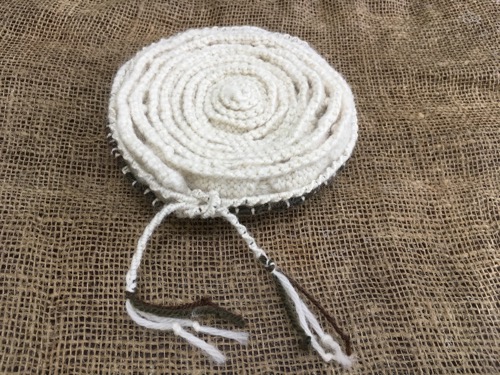
50th Birthday Piece for Tim
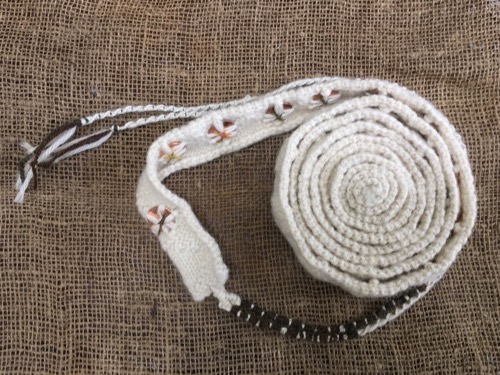
Birthday Piece Untied
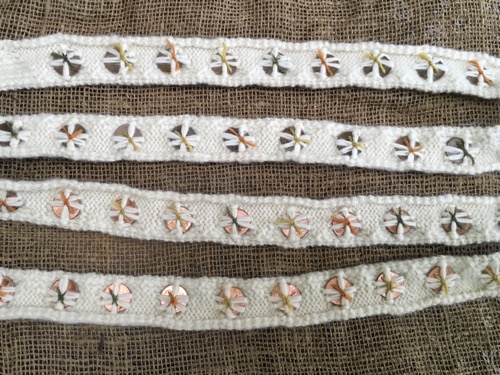
Bound Pennies 1966-2016. Each Penny is bound as part of code for Tim’s Name.
Dashes-Yellow, Dots-Green, Spacers-Orange.
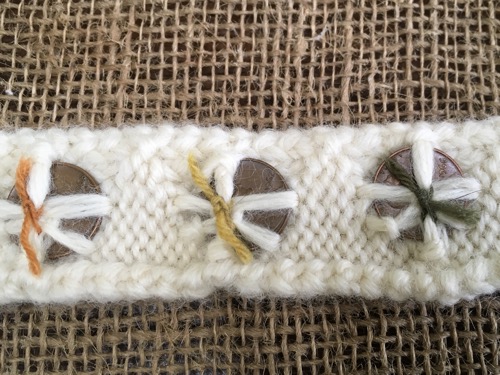
1968, 1967, 1966 Pennies
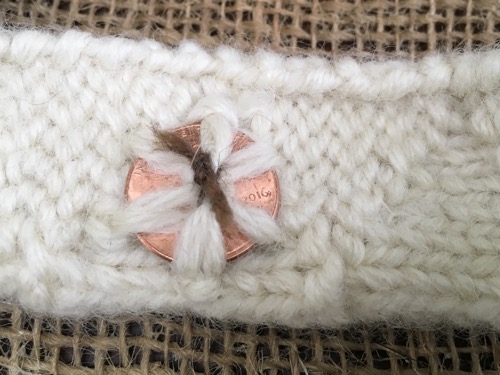
2016 Penny
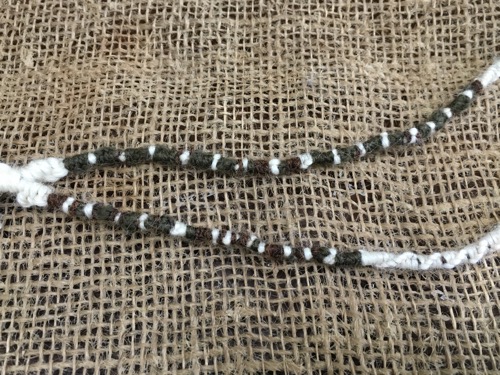
Top tie code is 09091966 and 09092016. Bottom tie code is Happy Birthday.
Dots knots are rust yarn, Dashes knots are green yarn, and spacers are cream.
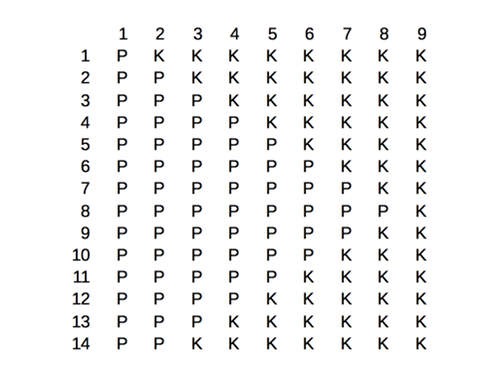
Loom Knit Pattern
Garden Damage and Critters
Every morning this summer the gardens have been damaged. Loads of digging.
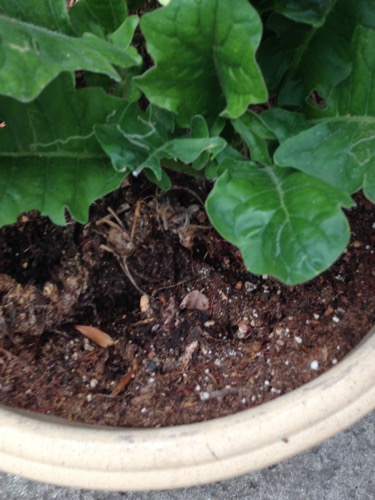
Digging in flower pots.
Four squirrels have moved in.The squirrels have eaten my potted plants, vegetables, and herbs.
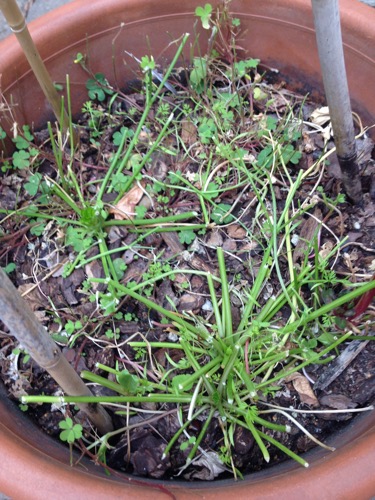
This was a pot of parsley, clover, and chard for my house bunnies.
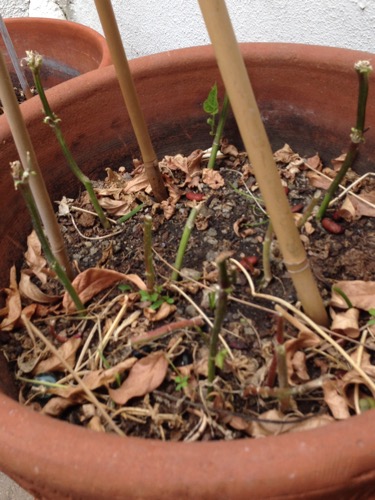
Where are the bean plants?
One squirrel sat on a wisteria branch and ate the top of my Norfolk pine.
Are they the ones digging up plants and the patio?
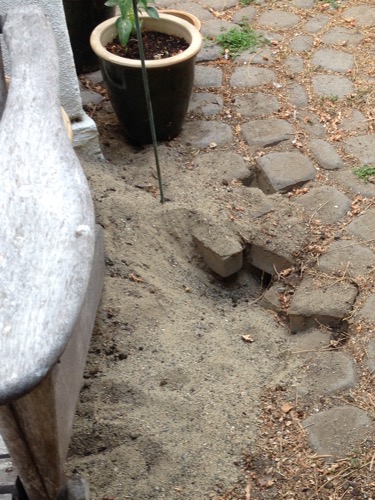
We decided that the squirrels needed to be relocated. We set up a humane trap. Placed a cracker with peanut butter inside and waited.
I heard the trap snap close. What did we find? The cracker gone and the trap empty.
Two of the squirrels are quite small, so it could have been one of them.
We put another cracher spread with peanut butter in the trap. Nothing happened.
Last night we forgot to close the trap.
And this morning we found this–
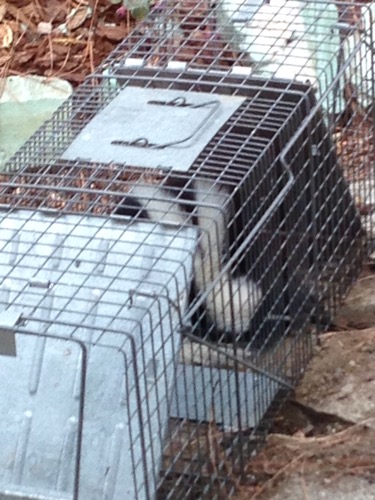
Yep, that is black fur with a white stripe.
We are fortunate to live in a city that has an animal control service. They came and removed the skunk.
What did we learn? The trap is too large for a squirrel. And if we use the trap again, close it or remove it at night.
Beyond the Pale
Recently the expression, “beyond the pale” has been used numerous times in reference to numerous things said by the republican presidential candidate. Yes that is numerous and numerous.
I knew what “beyond the pale” meant in the context, but did not know the origin.
Of course I did a google search. I found this great site, The Phrase Finder.
According to the site, beyond the pale is defined as the following:
This ‘pale’ is the noun meaning ‘a stake or pointed piece of wood’, a meaning now virtually obsolete except as used in this phrase, but still in use in the associated words ‘paling’ (as in paling fence) and ‘impale’ (as in Dracula movies).
The space within the paling fence was safe. Beyond the pale, not so much. Unless, protection becomes a trap.
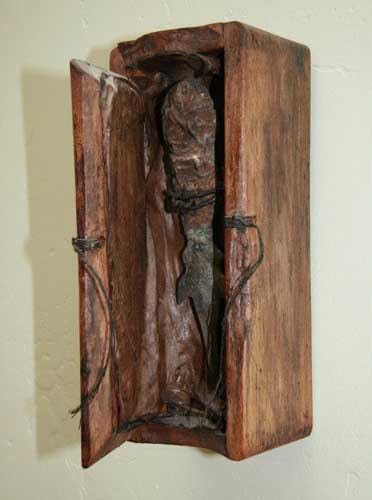
I do like sharp and pointy things, so I am delighted with the definition. Several years ago I made the series Tools for Rent. It consisted of 11 bronze daggers, each bound into a cedar box.
The Phrase Finder is a truly fun site to find meanings and origins of phrases you may be using and to find phrases you might like to add to your future conversations.
Pale is also a homophone (pail), so that could have possibly lead to some confusion. Loads of words when heard can be confused for other words.
A few confusion words in the previous paragraph:
so (sew)
Some (sum)
heard (herd)
for (four)
I will end with this quote from The Phrase Finder site bulletin:
The evil that men do lives after them,
The good is oft interred with their bones.
From Julius Caesar by William Shakespeare
Lichens and Glazes
When my chosen medium was clay, I used a lot of layered, often gritty glazes. In the back of my mind always thinking lichens.
Today when I was sweeping the deck, to my delight I found this piece has actual lichens growing on the surface.
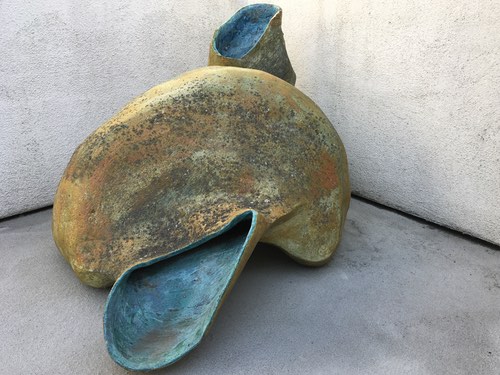
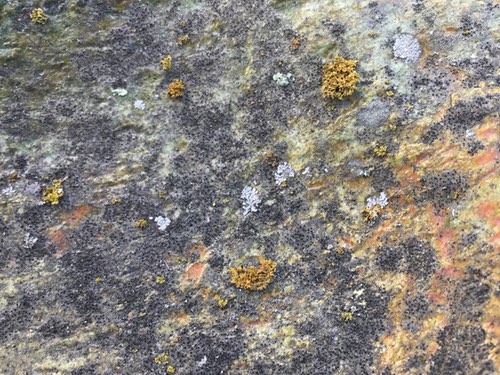
The piece was made in a class at Ohio State in the early 80s. The clay is a buff colored sculpture body with some nice aggregate. The piece was bisque fired to cone 5. A cone 05 lithium blue glaze was applied for the base color. Then low-fire lead glazes were applied. The last fired to cone 015.
The piece has been on the deck since 1994. It looks so much better with the addition of lichens.
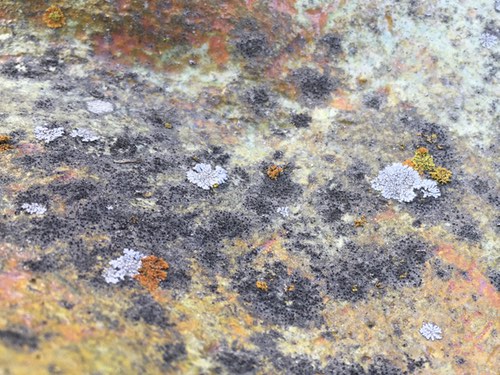
If interested in viewing lichen glaze surfaces, check out Lana Wilson’s work. Lana’s text, Ceramics: Shape and Surface has some great information for the beginner; and it also has loads of information on how to achieve gorgeous glaze surfaces. The text is available on Lana’s website.
A note about my use of lead glazes. Yes, they are gorgeous low-fire glazes. But lead is potentially dangerous. I haven’t been used lead glazes for several years. Since I have been attempting to use safer materials and processes, I reluctantly decided to remove all potentially toxic ceramic materials from my studio. I had quite the stash. I was fortunate that during the yearly clean-up, the materials were accepted for disposable without cost.
Did I really remove all of the lead from my studio? Well, I did keep a small bag of a leaded frit, just in case. I also found a small sheet of lead that I kept. It is a lovely soft material. I used it to line and wrap portions of boxes.
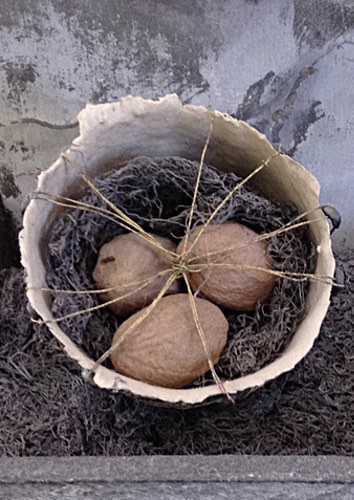
Detail of a piece in my Make Your Own Luck series.
The vertical section is wrapped in sheet lead.
The nest-like material is lead wool.
The three objects are whole nutmeg.
Nutmeg was used for luck.
If consumed it could be deadly.
Brachychiton Seedlings
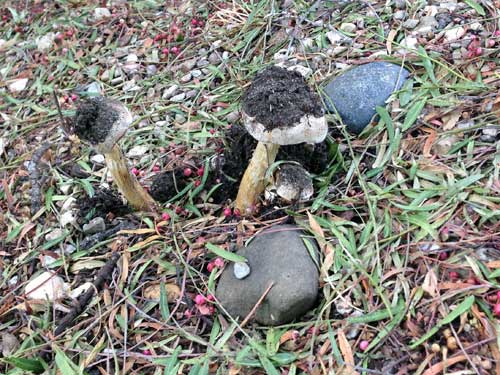
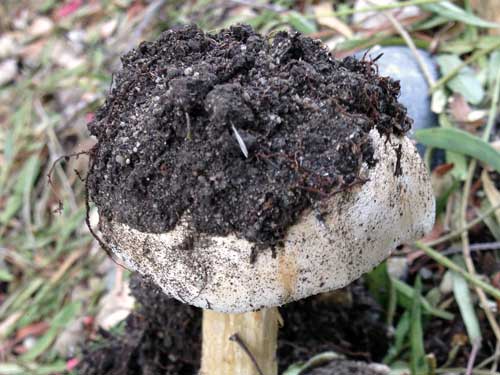
Fungi Colony
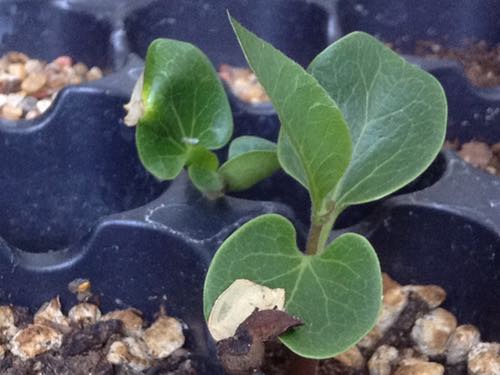
Brachychiton Seedlings
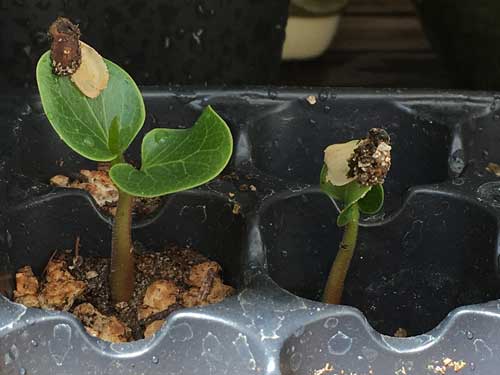
Brachychiton Seedlings A Week Later
Work in Progress: A Small Link to the Past
I was in the process of making a piece with grass that would have the coded message, A Small Link With the Past. As a test, I bound some grass to a piece of hardware cloth. The grass was a bit prickly, but I quite liked it.
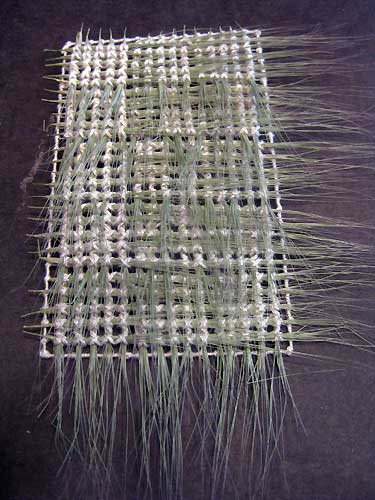
The plan was to bind grass to hardware cloth to make 3 pattern blocks…
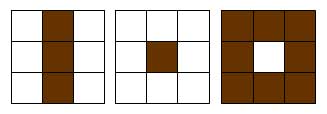
then bind the blocks together to make a pattern.
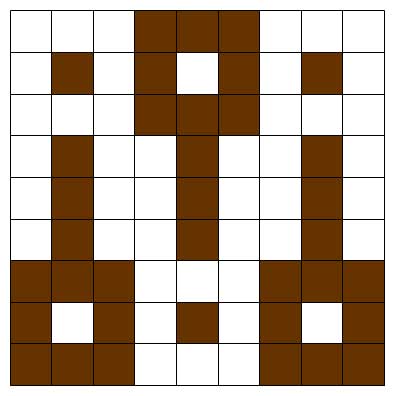
The pattern with the code will have 117 blocks, 81 will have the addition of a code component in the center square.
When I decided to use the 1/4″ hardware cloth the grass did not work. Instead, I am using Tecoma stans pods that have been soaked in a solution of glycerin and water.
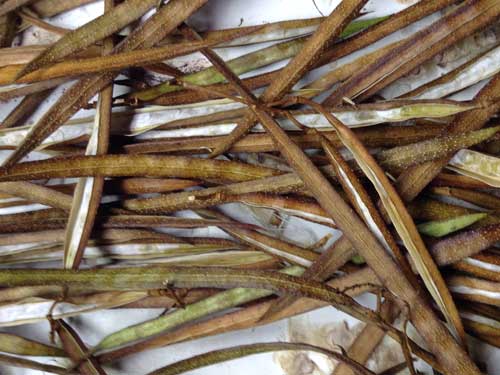
I wrote a post about collecting the Tecoma stans pods 12 November 2015.
Cream wool yarn will be used to complete the blocks.
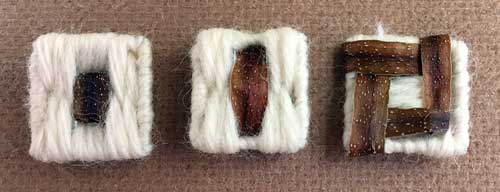
I just noticed when I shot the photo of the blocks, the one with the cream wool center should have been rotated for the stitch work to be vertical.
Unfortunately, making blocks in low light while listening to political news resulted in several mistakes. In order for the pattern to work properly, the grain of the pod must be bound vertically.
The right block works, the left one does not.
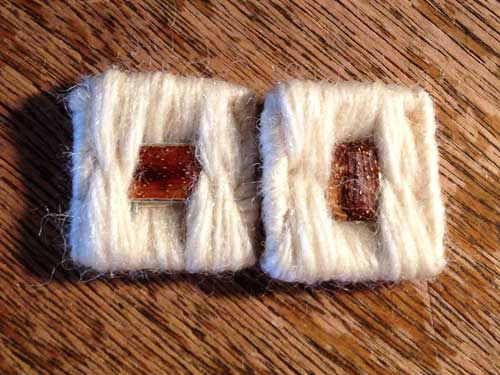
The dozen that I consistently stitched incorrectly can be used for a different project. It will be easier, and less time consuming to replace the mistakes than to take them apart and rework them.
There is another issue with changing from grass to Tecoma sans pods. Grass fits with the idea of linking to the past, a childhood memory. Tecoma sans pods does not.
So, how will the pattern work as a connection to memory, or a link to the past? The pattern with the code will be a portion of the piece. Grass, hardware cloth, and wool will be woven together, most likely with the word memory in code, and the pattern with code will be bound to it. That is the current plan, but things can change during the process.
Rescue Cactus
Every time I hike the hills at the end of our street, I pass by a cactus. The blooms of the cactus are white, large, and gorgeous. A month or so back this is what I saw–
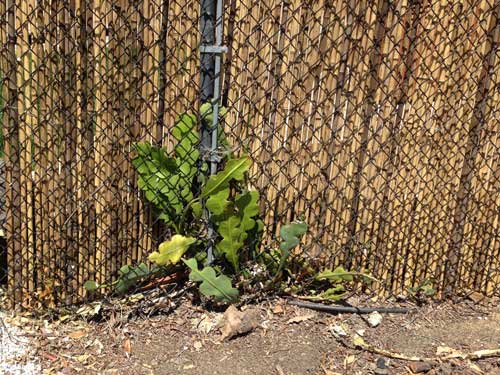
What were they thinking??? Sure it is nice to add a privacy fence, put what about the cactus?
I found some broken pieces on the ground. So, of course I scooped them up and brought them home. This is how they look today–
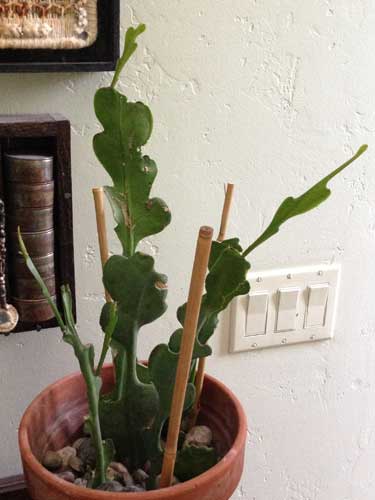
Some of the pieces are scarred from their previous home, but they are all thriving. Every piece has new growth!