But is it art?

Holey Tree

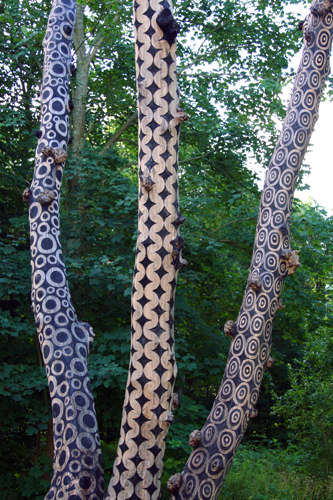
This is a tree in the backyard of where I am staying in South Carolina. When I first saw the tree I thought the depth and regularity of the holes were made by a person. And if they were made by a person, does that make it art?

Holey Tree Detail

The holes were made by a woodpecker.

I think the surface is beautiful. It brought to mind images of coins inserted into the bark of wishing trees and the story of pigs teeth inserted in a tree in the film Howards End.


Pink Rabbit

I went to grad school at WSU in Pullman, Washington. One of the first people I met was
Tim Timmerman. We became friends right off, and still are after 20 some years.

While I was cleaning and clearing, I ran across the pink rabbit Tim used as a model for one of the pieces in his grad show. I liked the piece quite a lot. I asked if I could have only the bit with the rabbit painting. The piece was quite large and I didn’t have a place for it. One day a print of the rabbit bit arrived. What a great and thoughtful gift.

There is a tad more to the pink rabbit story. Tim and I would go junking together and on one of our excursions, Tim found the pink rabbit. It was such an enjoyable day.

While removing some of the chaos of possessions from my life, I packed up almost all of the bunny items that I have collected over the years. Couldn’t pack up the pink rabbit. So, I gave him a shelf under the print of the painting.

Pink Rabbit

I was so delighted to find a very cool sketch of a bunny on Tim’s website.

Tim’s Rabbit Sketch


Cleaning, Clearing, and Great Finds

I recently wrote a post about finding Casemaking Moths in my studio. Finding the moths was rather perfect timing. I had planned to eliminate some of my stuff. I knew that would be a difficult task because I have the habit of collecting loads of “potential” art materials for “someday.”

After reading several posts about lessening chaos and removing clutter on Zenhabits and Discardia, I liked the idea of photographing unused or sentimental items and then discarding them. That was until I began looking through and touching the past.

I was able to remove 17 boxes of books from my shelves. The shelves didn’t stay empty. I now have a clean place to store some of my small completed pieces.


I found a folder of newspaper articles that was labeled, “Odd.” The first article had the headline, Chicken With Prosthetic Legs Mauled by Dog. The other headlines were just as unusual, hence “Odd.”

There was a folder of items about artists. I made a pile of articles on artists that I liked quite a lot to google. A couple of favorite artists–

Marsha Pels’ Solstice still excites the heck out of me.

Marsha Pels Solstice 1993

The article about Kate Hunt’s work had an image of Marriage (For Todd) Torrington dated 1997. She made newspaper and bailing twine into something beautiful. When I visited her website I found Trophy.

Kate Hunt’s Trophy

The piece has the addition of steel, encaustic, and boat building epoxy. I wonder how it smells?


Back to cleaning and clearing–an interesting thing occurred. I am from the generation when you had stacks of slides to document your work. What should I do with all of the slides that I haven’t digitized? I am thinking that it would be a waste of time to digitize most of the really old work. Potential art materials?


I have always been a compulsive note taker. I have all of my notes from all of my art classes that I took and taught. Whenever I start a new series I spend a great deal of time researching. I have binders full of notes.

I use composition books for sketchbooks and go through them rather quickly. I always index the books but trying to find a particular sketch or code takes some time. I thought about scanning the sketchbooks and notes, but thought better of it.

Pretty sure that I am going to set up a camera and shoot them. That would be just like how folks of my generation shot images from books to use in class and for papers.


A Perfect Environment for Moths

I suspected that at some point, I would create the perfect environment for some type of insect. When you have loads of dried plant materials and fiber it is rather likely some critters will move in.
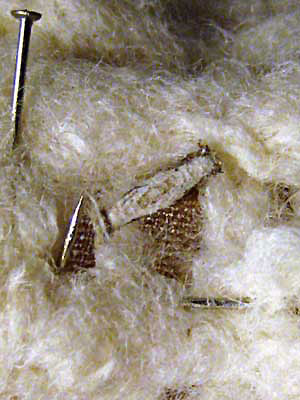
Moth 1

This is a detail of a work in progress. It would have been a cup made of wool and rayon that I just couldn’t manage to finish. The head of a straight pin is in the upper left of the photo, and the tip of a pin is next to the casemaking moth.


How Did I Find Moths?

I read an article that stated empty birds’ nests should be removed from around your house because casemaking moths might take up residence. I had a collection of nests containing little vignettes in my studio. When I checked them, I found casemaking moths. After the shock wore off, and the sinking feeling that everything in my studio might be destroyed; I methodically started the hunt for the critters. I discarded materials and several works in progress.

I did a test to see if I can save a piece if it is found to have moths. I soaked some works in progress that had been attacked by moths in vinegar for a couple of days, rinsed in water, and laid them in the sun. My hope is that if there were eggs, they were killed.

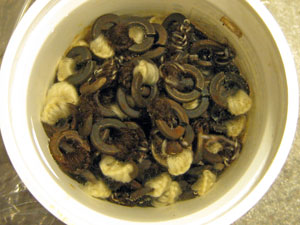
The vinegar soaking changed the appearance of the pieces. I bind fiber onto washers for use as coding components. The bottom row was soaked in vinegar. The washers are not the same type, but they have a similar composition. The fiber is wool that sustained a color change due to the oxidation of the metal. The change in color of the cream wool is not to my liking, so the solution would be to age the washers, then bind them.
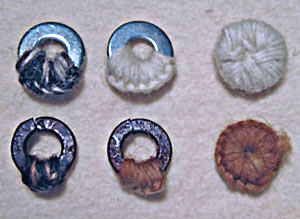
washers

If the same or similar result occurs the next time I use a vinegar bath, I’m pretty sure that I will use the technique in the future to age some pieces. It is simple and non-toxic.


I found the casemaker moths–

  • on the back of a framed piece
  • on older books, the bits facing the wall
  • in the bottom of a bowl that contained components for projects
  • in baskets of materials
  • on woven pieces
  • around baseboards
  • behind doors
  • under furniture
  • even inside a spare pair of work shoes

Some insects are attracted to a particular color, fragrance or pheromone, or a location. I did not find a pattern or consistency in where they made their homes.
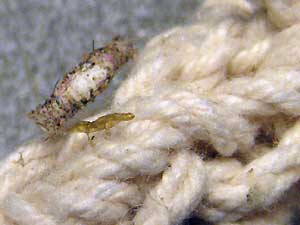
Moth 2

And it does not seem to matter if the fiber was impregnated with wax or shellac. It may be too early to tell, but I do not think that they took up residence in or on any of my work that was treated with salt.

This is the edge of a piece of foam core that I used for a photo set-up.
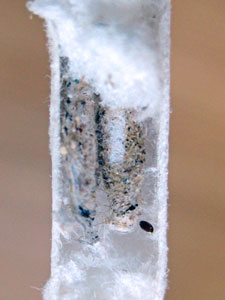
Moth 3


For More Information From Reliable Sources–

Casemaking Clothes Moth AgriLife Extension Texas A&M

Clothes Moths by Mike Potter, Extension Entomologist, University of Kentucky, College of Agriculture

Clothes Moths University of California Agriculture & Natural Resources, Statewide Integrated Pest Management Program


My “Real” First Comment

I received my first real comment on one of my blog posts from Dinah at Discardia.

Yesterday I spent the better part of the day cleaning my studio space because of the moth scare. I decided to clear out the truly unneccesary “potential” art materials. Throughout the day I kept asking myself, “What would Dinah do?” At the end of the day, there was her comment.

Serendipitous.

Uncertainty about my choices faded; I felt validated.

I did have a weak moment, one in which I felt a bit overwhelmed with the task at hand. To calm my mind I typically do one of two things–read or bake. I opted for baking chocolate chocolate-chip cupcakes with chocolate frosting.

Vegan of course.

The recipes are based on Jennifer McCann’s book, Vegan Lunch Box–Triple Chocolate Cupcakes and Chocolate Vegan Buttercream.

After a cupcake I went back to my studio refreshed and ready for the task. I needed to stop addressing the cleaning and clearing in a random, willy nilly way. I needed to be methodical.

I started with the first set of shelves where loads of small open containers of bits are stored. Interesting that the boxes of jars that I was keeping for someday came in handy.

Box of Jars

Yeah, I am pretty sure that I am not going to make snow globes.

And lids will keep out unwanted critters.

Stuff in Jars

Nathanael “Big Baby” and “Queen” Nora appreciated your comments too.

Big BabyNora


Tinea pellionella

The past weekend I found some fiber looking somethings near the baseboard in the family room. On closer inspection and after a google search I found out the terrible news. They are Tinea pellionella, casemaking moths.

They are known as casemaking moths because according to the Statewide Integrated Pest Management site of University of California Agriculture and Natural Resources, “…always carry a silken case with them as they feed. They never leave this silken tube, but enlarge it as they grow.” Apparently the case is supposed to be the color of the fabric they have eaten. Most of the critters I found on the gray-green wool carpet are rather tan.

So here is the thing, if they stay in their silken vessel and it grows with them, and they are rather small when I find them, two questions come to mind.

How long have I not seen them?

And how many are there that I can not yet see?

Totally creeps me out.

Apparently, the female can lay “an average of 40 to 50 eggs…” but I was unable to find out how many of those eggs will be viable.

Most of the information I found indicated that pyrethrin was the solution. I do not want to use dangerous chemicals. We share our home with house rabbits who frequent the space. Any chemical residue could end up on their fur which could be potentially dangerous when they groom themselves or each other. Actually if there are fumes, respiratory problems could occur as well.

I emailed my friend at the UC Botanical Garden to find out how to handle the situation. After talking with him, I pretty much decided that I would give the carpets a good cleaning and then probably try an application of Diatomaceous earth. Unless I opt for the new information that I found tonight on the Northwest Center for Alternatives to Pesticides site. The article stated that while cold temperatures are not effective, placing a space heater at 120º for 4 hours in the room where the moths have been found can be.

Then the horror of horrors occurred to me. I had read that it is a good idea to remove all bird nests near your house. The moths find nests a great place to thrive. I got a sick feeling when I realized I have nests in my studio. What if the moths have gotten in my studio? I have several pieces in progress, hung, and stored in the space; many have a fiber element. I started on one wall and made my way around the space. And it was confirmed that they really do like nests and even some of the work in progress had been attacked.

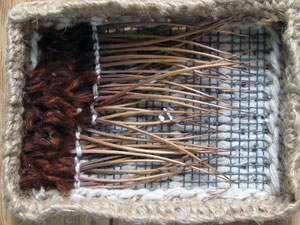
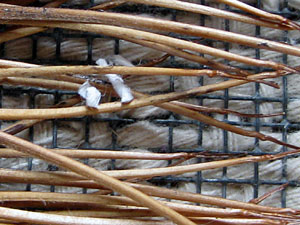
This is the interior of a lid that has protea seeds bound to hardware cloth.

Protea Lid

Protea Lid Detail

Some work that is constructed of bound plant material and coated with wax had evidence of moths. There was one bronze and ceramic piece that had a single critter attached to its underside.

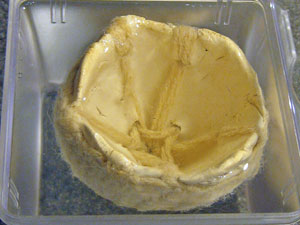
I disposed of most of the work. It was amazingly invigorating throwing out stuff. Then I found a ceramic cup bound with wool that had an application of shellac. I placed the piece in a container of vinegar.

Bound Cup

I also had bound some split washers for a code piece and noticed there were a couple of critters in the container so I dumped the lot in vinegar. There is a single floating critter.

Bound Washers

What I do not understand is why they did not attack the larger wool pieces that are in progress, but they did attach themselves to one of my clean work shirts hanging next to them. I’m glad it was the shirt.

Tomorrow I need to do a thorough cleaning of my studio.


Sometimes Forwarded Email Can Be Great

I remember seeing a television program about the Wieliczka Salt Mine on PBS, TLC, or the History Channel. So, when I received an email with images of the mine I was delighted.

Unesco Image of Wieliczka Salt Mine

Then a very cool thing happened. The attached link took me to the UNESCO World Heritage site which has loads of amazing information and images of places of cultural importance categorized by country.

I plan to spend some time on the site in the near future.


Environmental Art

Early on in my education at Ohio State University, I became aware of artists who would go to a site and use the materials present on that site to make a work. Often the work appeared as though it occurred naturally.

I had a romantic notion of visiting the woods near my parents’ home, connect with the site, and make a work. When I attempted it, I realized right off that I wasn’t alone. There were snakes, mosquitos, and ticks, all of which creeped me out.

I recently read about Stuart Wood’s environmental work on the Studio ‘g’ blog. The images of his scorched patterns on trees gave me pause. I like the idea of using a scorching process to alter a material. And that controlling a potentially destructive process can result in something beautiful.

Stuart Wood's Bandelier

When I visited Stuart Wood’s website I found many gorgeous pieces. And I admit that I found myself saying out loud, “…really, seagull feathers.”

Stuart Wood's Alsomitra


Is it Toxic?

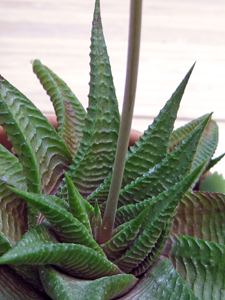
I often use dried plant parts in my work. Typically the plants must have some interesting tactile quality, be toxic, and have a cultural myth or superstition. I was looking through a stash of dried plant parts and found some Haworthia limifolia leaves. They have great texture with sharp and pointy tips.

Haworthia

I googled Haworthia limifolia looking for information. I was a bit disappointed that the plant isn’t toxic. Apparently it is often used in place of Aloe for skin ailments. I did find a line that popped up in several articles, “Haworthia limifolia is often used by traditional healers as a spiritual remedy to ward off evil.” Curious. What kind of evil?

I have a contact at the UC Botanical Garden so I sent him an email inquiry about the plant. The plant is one that he gave to me several years back. He sent me a pdf of an article that I hadn’t read, Lightning Birds and Thunder Trees authored by Adrian Koopman. The article states that Haworthia is used as a charm to protect against lightning.

We don’t see much in the way of lightning where I live. Before reading about the plant’s reference to lightning, I had already bound the bits to a piece of hardware cloth to become part of a lid. My work must have the appearance of a life lived, so I age the work using one or more techniques–wax, heat, fire, salt, molten sugar, chemicals… and sometimes I bury the work.

Haworthia for Lid

The Haworthia bits are bound to the hardware cloth with cotton and bamboo fiber which works great with all of the techniques.


A few lightning information links–

S.A. Weather and Disaster Information Service, South Africa

Global Hydrology and Climate Center

StruckbyLightning.org

Mortality Statistics–Victim of lightning by country

NOAA National Severe Storms Laboratory


Mix of Stuff 16 February 2012

Today I was asked to make a red target icon that doesn’t look like the target used by Target. I googled archery targets to get a notion of what might be visually expected. I didn’t remember that the center of a target could be yellow.

Whenever I perform searches for work projects, I often receive hits that are of personal interest. Today I found arrows at the Museum of Anthropology, the University of Missouri. I made several series based on weapons, so I’m always delighted to see lovely artifacts that also have a dark edge to them. I especially like sharp pointy objects.

Arrows1Arrows2

According to the site the artifacts are Javanese target arrows. The description states that the shafts are made of bamboo, a material that I have used quite often in my work. I found that it was a bit difficult obtaining the surface that I wanted until I hit on using heat. Beware though, bamboo can catch fire from the inside. Before you know it, your piece can be aflame.

I chose to use bamboo because it is a prolific grower, its cultural myths, and its use in a variety of rituals.

After I finished the icon job, I went out to water a newly planted hellebore. I noticed that the bottlebrush in the courtyard apparently doesn’t like its location. It is thrusting out from the house and in doing so appears to be using a bunny ornament as a support.

Weight

When I went back to proofing the database of thousands of words, I found a couple of interest–

antemeridian
of, relating to, or taking place in the morning

antefix
carved ornament at the eaves of a tile roof concealing the joints between tiles