Work in Progress: A Small Link to the Past

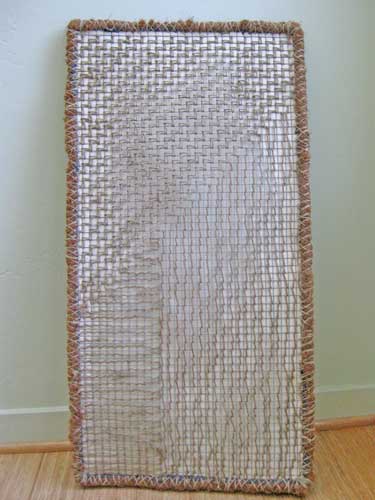
I was in the process of making a piece with grass that would have the coded message, A Small Link With the Past. As a test, I bound some grass to a piece of hardware cloth. The grass was a bit prickly, but I quite liked it.

Grass Piece

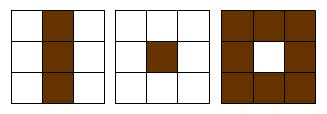
The plan was to bind grass to hardware cloth to make 3 pattern blocks…

Blocks for Pattern

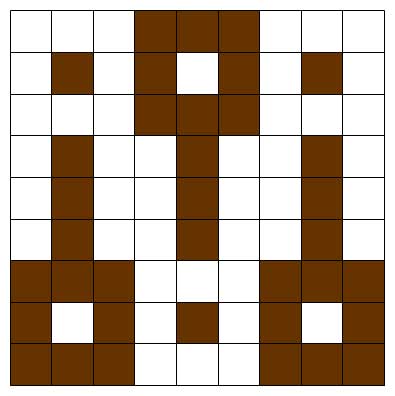
then bind the blocks together to make a pattern.

Pattern

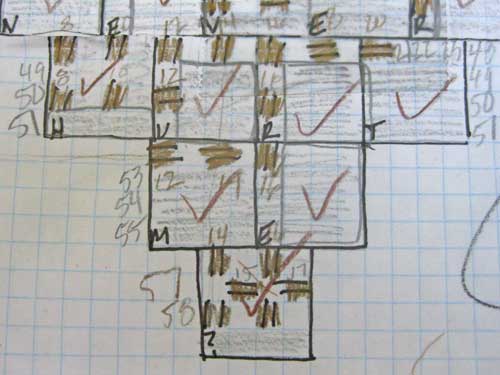
The pattern with the code will have 117 blocks, 81 will have the addition of a code component in the center square.

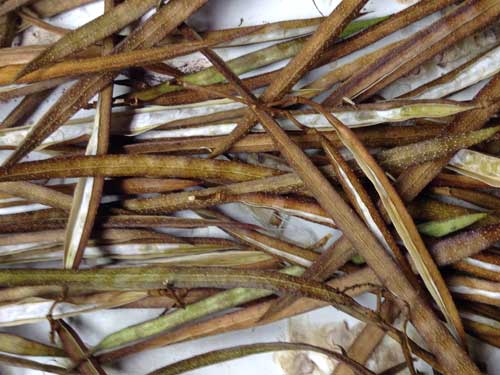
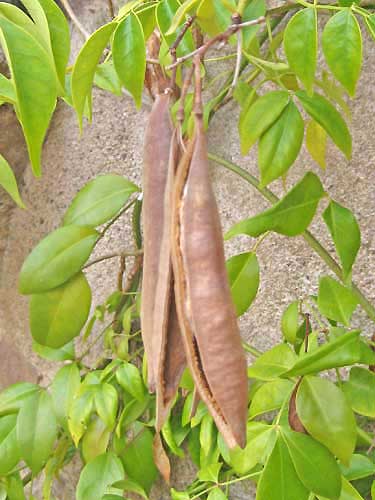
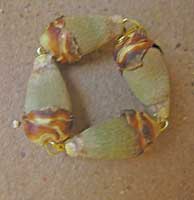
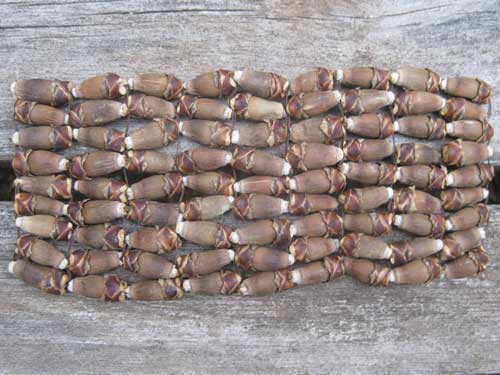
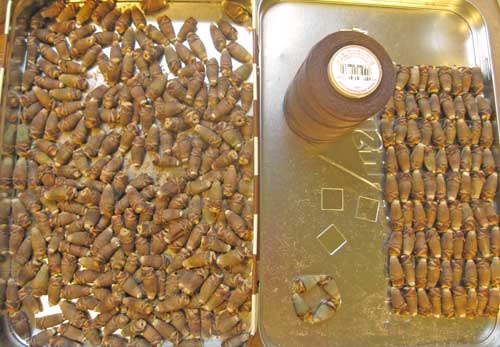
When I decided to use the 1/4″ hardware cloth the grass did not work. Instead, I am using Tecoma stans pods that have been soaked in a solution of glycerin and water.

Tecoma sans Pods

I wrote a post about collecting the Tecoma stans pods 12 November 2015.

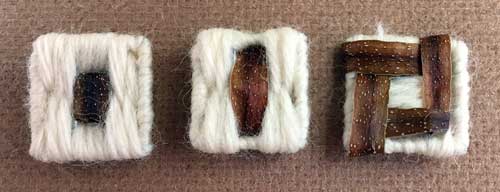
Cream wool yarn will be used to complete the blocks.

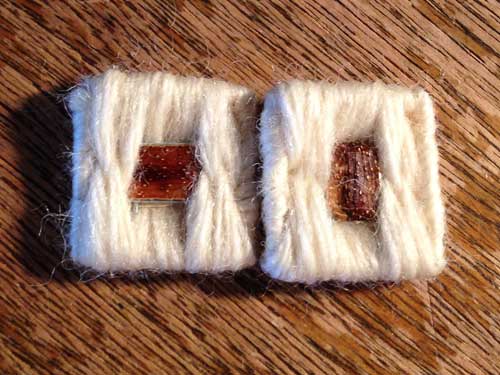
Link Blocks

I just noticed when I shot the photo of the blocks, the one with the cream wool center should have been rotated for the stitch work to be vertical.

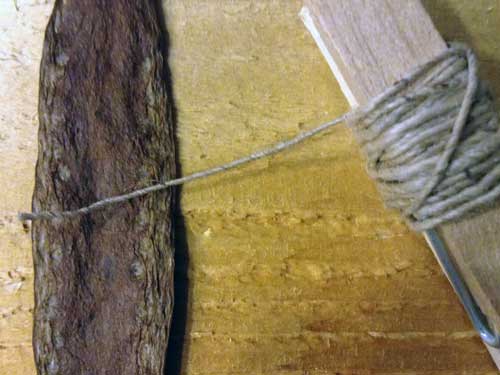
Unfortunately, making blocks in low light while listening to political news resulted in several mistakes. In order for the pattern to work properly, the grain of the pod must be bound vertically.

The right block works, the left one does not.

Link Block Mistake

The dozen that I consistently stitched incorrectly can be used for a different project. It will be easier, and less time consuming to replace the mistakes than to take them apart and rework them.

There is another issue with changing from grass to Tecoma sans pods. Grass fits with the idea of linking to the past, a childhood memory. Tecoma sans pods does not.

So, how will the pattern work as a connection to memory, or a link to the past? The pattern with the code will be a portion of the piece. Grass, hardware cloth, and wool will be woven together, most likely with the word memory in code, and the pattern with code will be bound to it. That is the current plan, but things can change during the process.


Work in Progress–Accustomed to Being Invisible

Have you ever been standing in a shop looking at what is on the shelf a few feet away, suddenly someone walks in front of you, and in between you and the shelf? You step back, out of their way, because you were not seen. Have you ever walked up to an automatic door and found yourself standing there waiting for the door to open? Your presence was not recognized by a sensor. How many times have you touched your iPad screen to open an app and nothing happened? Could you be invisible?

Got to thinking about, well being invisible. And since most of the time I don’t really care if I am noticed, I started thinking about things of substance in nature that are hidden or invisible. Things that have an important function, but remain hidden to the casual viewer.

I am in the process of using plant parts that are typically hidden in my invisible series. The parts are beautiful, often with patterns imprinted on them as the result of their function in the life-cycle of the plants.

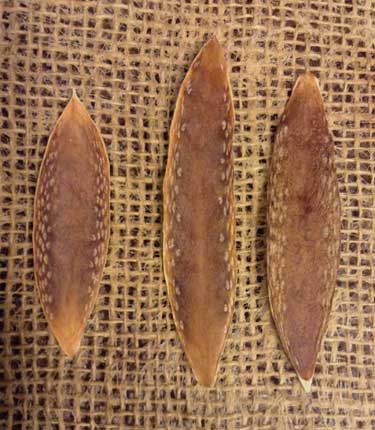
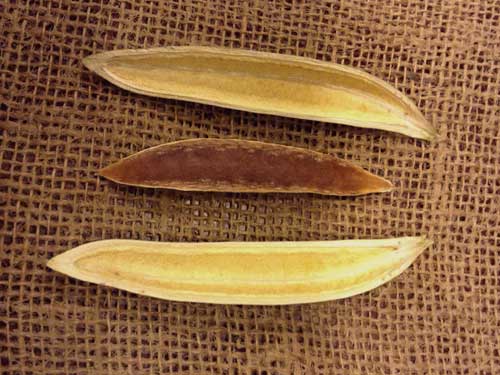
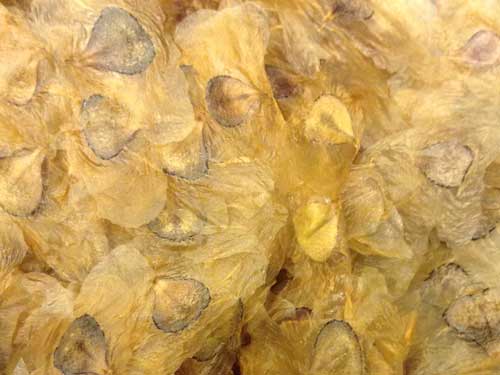
Interior Bits

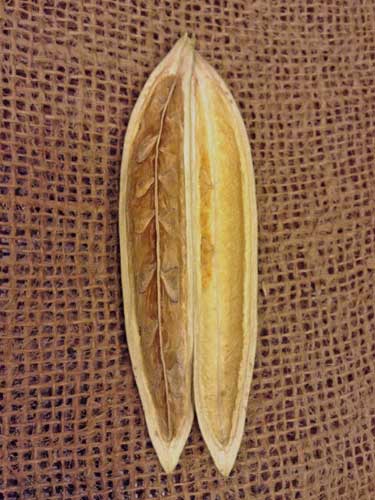
These are the interior bits of Pandorea jasminoides. I collected some pods that I thought would be fun to use. When I opened the pods and removed the seeds, I found these beautiful shields.

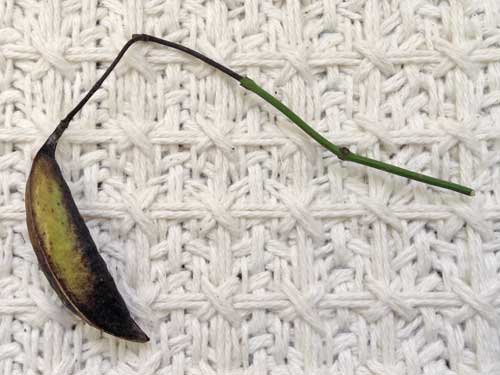
I recently purchased a Pandorea jasminoides, specifically to harvest the pods, seeds, and other interior bits. This is the first harvested pod.

Pandorea jasminoides pod

Glycerin Mixture

The Pandorea jasminoides bits were soaked in a glycerin solution to make them more pliable and easier to stitch.

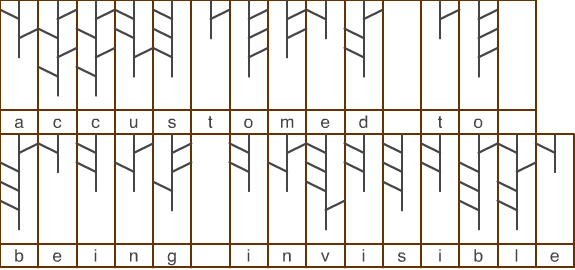
Invisible Code

Code to be used on Pandorea jasminoides bits.

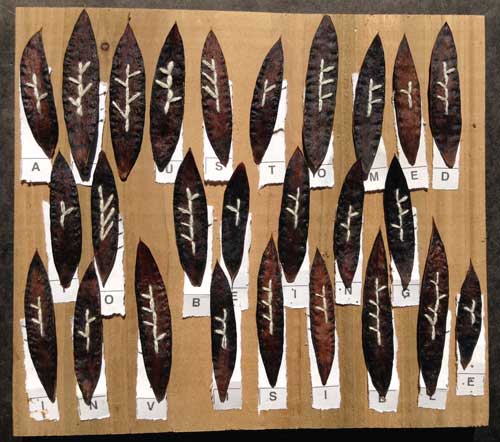
Invisible Stitched

The Pandorea jasminoides bits were stitched with Alpaca Lace yarn. Each piece was stitched with a letter of the quote–accustomed to being invisible.

The current plan is to make a page with the coded pieces on one side and a bound small round mirror of the other side. I seriously thought about making knitted and fulled pages, but I am not pleased with the results, yet.

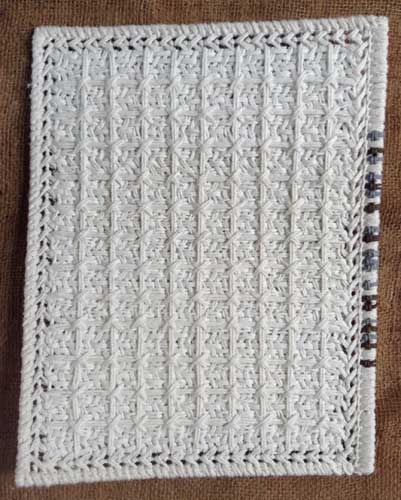
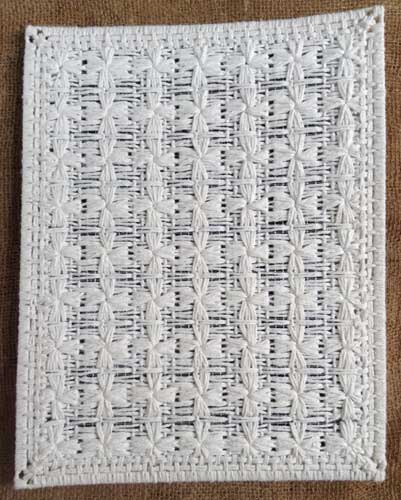
Decided to try using some embroidered pieces for the pages.

Front Page

The right side has–take notice in code. Not sure that I like it.

Back Page

Each embroidered piece is 45 squares (11.25″) wide and 58 squares (14.5″) high. The openness of the stitches is one of the reasons for using the roofing felt in between. I love roofing felt–the way it feels, smells, and looks. I started using roofing felt when I was investment casting. Some of the roofing felt that had been used in the casting process had lovely plaster stains. I liked the used roofing felt so much I used it in my Headbox series.


Books and the Book Series

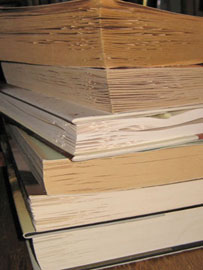
Books have always been a part of my life. When we were children, my mother would take us to the library. When I was in college I would spend part of a day each week wandering through the stacks. After grad school, I started my library. I have nearly 1,500 books. There are books on art, artists, film, graphic design, gardening, horticulture, novels, children’s books, textbooks, and miscellaneous books on random topics.

I love reading, the way books feel in my hands, turning the pages, the fragrance of paper and ink. I was taught to respect books, but then something happened. I found that I really liked underlining. That grew to writing in the margins and using any white space to record ideas for possible work. Then I started folding corners and pages.
Books

When I open one of my books to locate a quote or some notes that I have made, it is quite enjoyable to revisit the story, to read a few pages or several chapters. To remember the first time that I read the book.


I resisted reading e-books. My iPad is thin, slippery, and has a bit of glare. How would I dog-ear pages, write in the margins, underline…

I tried reading a few books on my iPad and in doing so found that I could customize the text. I could make the text large enough that I no longer needed to wear glasses. I also found that I quite like reading light text on a black background. And I could read in the dark.

Then I found how easy it was to highlight, bookmark, and make notes. I could download the lot from amazon. A few adjustments to the downloaded file and I could import the text into my database of quotes and phrases. Yep, I have a database of words, phrases, quotes.


I have thought about making books, but one thing always stopped me. What will be on the pages? The thought of an empty book, seemed incomplete. I actually attempted constructing a few books over the years.
Twig Books

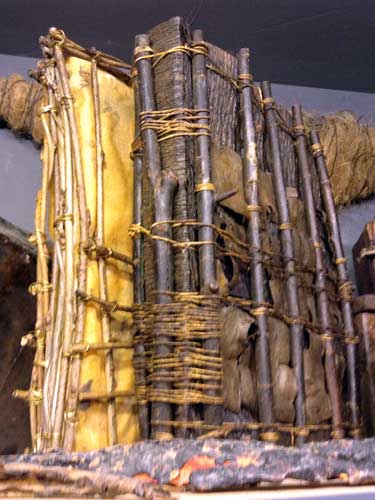
A couple of books constructed of materials collected from nature, fabric, paper, copper wire, and waxed linen cord. I saved a couple to remind myself why they did not work.

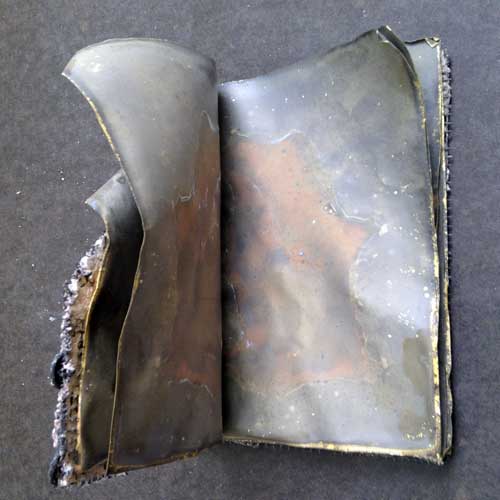
I also made a series of small books constructed of hardware cloth covers coated with Egyptian Paste. The covers were fired to cone 016. Hot enough for the clay to mature, but not hot enough to melt the hardware cloth. I cut copper and aluminum flashing for the pages. I bound the pages and covers together and fired the lot.
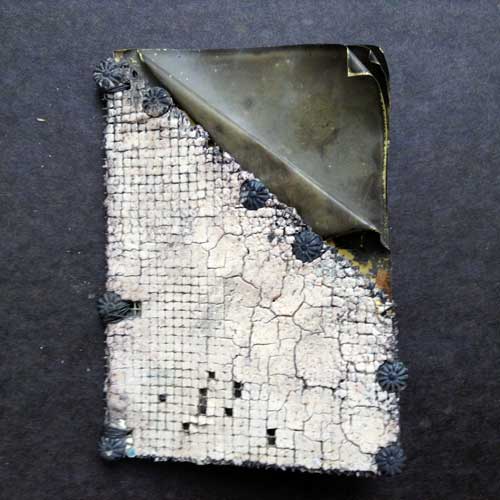
Egyptian Paste Book

Egyptian Paste Book Open

The pages have a lovely surface, but they are still empty.


The past several years I have used coded messages in my work. It is quite enjoyable to figure out ways to put text in my work that cannot actually be read as text but is seen as pattern. Well, the text could be read if the code is deciphered. And since I am not a cryptographer, it isn’t too difficult to figure out.
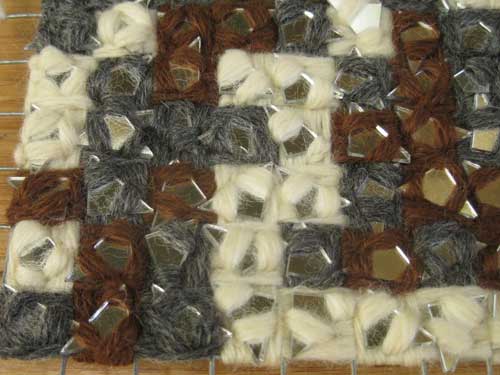
Dont Detail

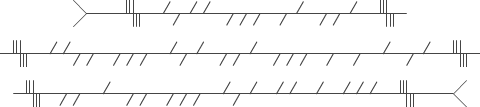
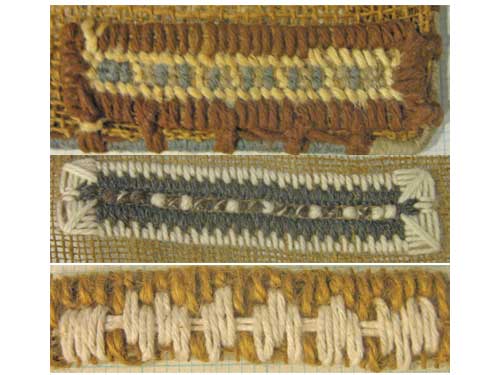
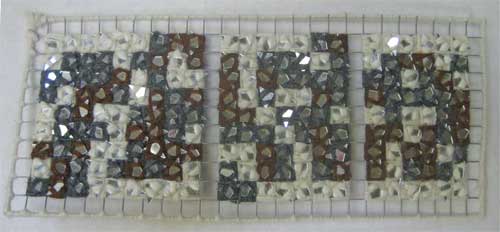
This is a detail of code in a work that I have since completed. I used Morse code with rust yarn for the dots, gray yarn for the dashes, and cream yarn for the spacers. The bottom left corner has gray, rust, gray which is dash-dot-dash or a k.


I have decided to revisit books again with the idea of including coded text. Each book will have a theme: connection, grief/loss, invisible/visible, kindness, memory, nature, perception/seeing, power, reflection, self, truth…

My plan was to make wool knitted and fulled pages, with stitched coded messages, and dried and stitched plant bits. I knitted all sorts of stitch patterns to see which stitches would work best.

Then something unexpected happened. I had a dream, an epiphany. In the dream rather than making books I was making pages and framing them as artifact. Framed fragments of pages would be more compatible with my body of work. Was my creative self giving me a message or was the dream a mash up of a bunch of things that I had been thinking about throughout the day? No matter, I like the idea.

I began to approach knitting differently. Rather than knitting rectangles for book pages, I wanted the pieces to be odd shaped.
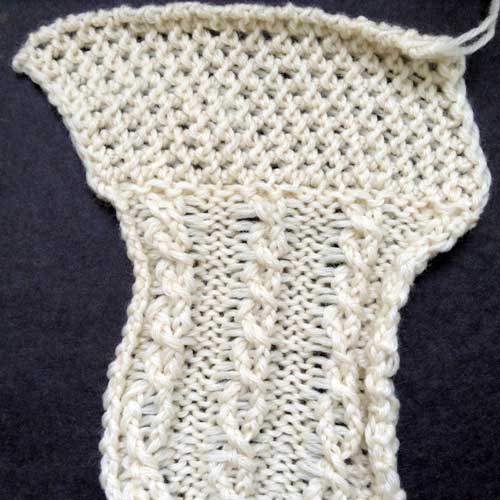
E wrap Purl Cable

The top portion was knitted. The piece was removed from the loom, rotated 45º, returned to the loom, and then the cable pattern was knitted.

Top Portion
Row 1 E-wrap (each peg twice)
Row 2 Purl (wrap)

Bottom Portion (Cable)
Row 1 Knit
Row 2 Purl
Row 3 Knit
Row 4 P,P, Twist Knit, P,P, Twist Knit…

This is the back of the above piece. It is important that the back is interesting because both sides of a page can be visible.
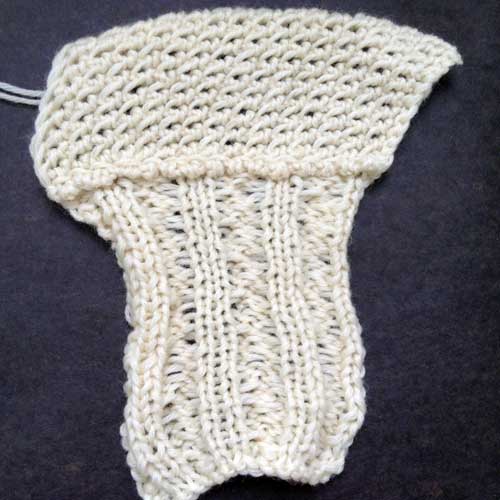
E wrap Purl Cable


This combination of stitches is quite nice. There does seem to be some consistency in my choices. It appears that I like knot-like stitches.
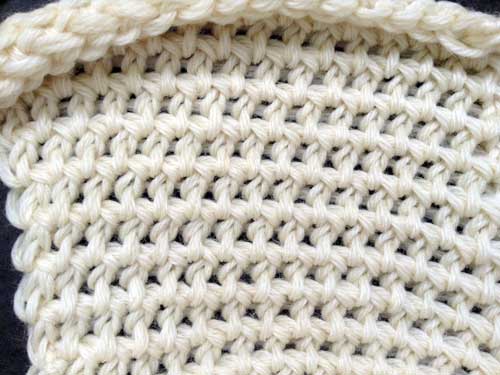
Figure 8 with E-wrap

Row 1 Figure 8
Row 2 E-wrap

If after fulling, the fabric still has holes, I plan to either weave in yarn or an i-cord.
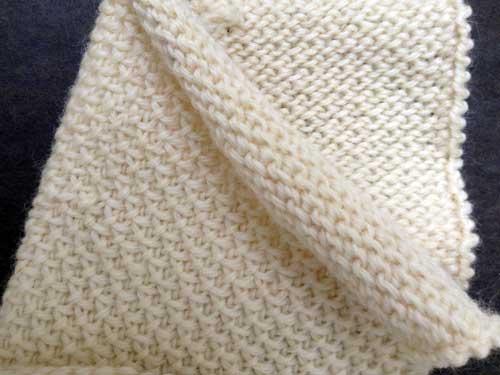

Linen Stitch

The idea was to knit a long piece, full it, and fold it in half to create a signature. Then bind several signatures together.
Row 1 K all
Row 2 K, S… K
Row 3 K all
Row 4 S, K… S

It will be fun to see how the series evolves.
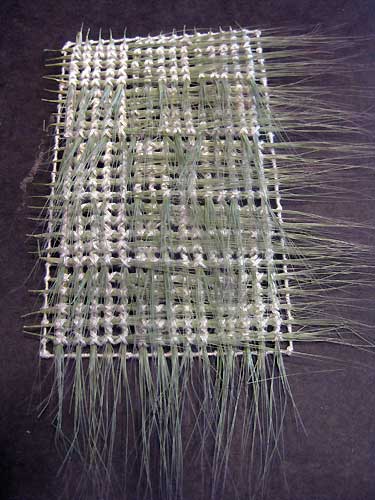

Slat Book and the Bead Loom

Last night I was looking through some work in progress and saw a bead loom. It was a gift that I never used, but thought it might come in handy for something, some day.

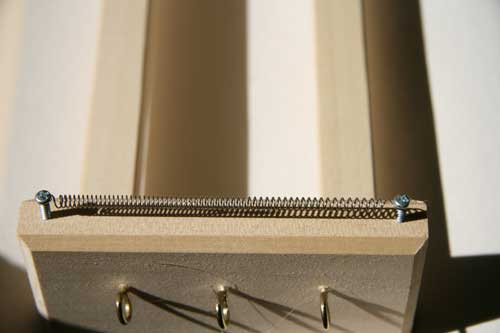
Bead Loom

A bead loom is basically springs attached to a wood frame. In my limited use of springs, it makes sense that a larger spring would work when weaving thicker fiber.

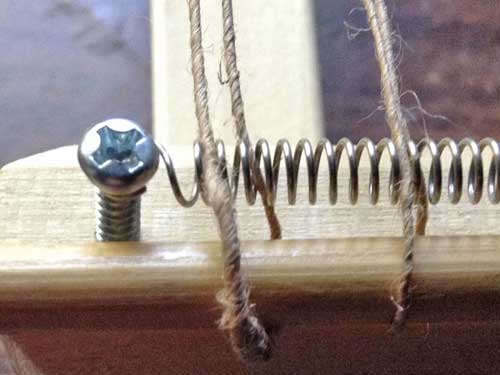
Something that did occur to me when removing the piece from the loom, it would be a good idea to place a rod next to the spring and wrap the fiber around the rod before placing in the spring.

Bead Loom With Rod

After quickly trying my idea, I found that there was a need for clamps to the hold the rod in place.

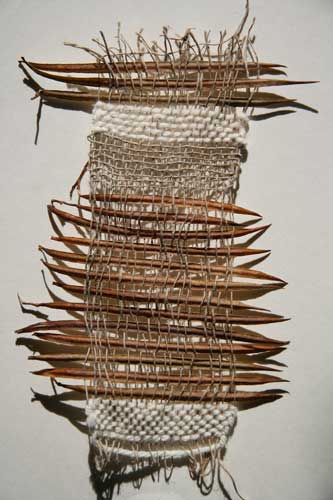
Back to the weaving experiment: I strung the bead loom with some nettle and started weaving. I used cream wool, nettle, and Tecoma pods.

Bead Loom Result

The result is exciting because it might be the solution to my slat book problem. I plan to use Pandorea jasminoides parts, stitched with a letter in code.

Plant Bits

Slat books typically use regular shaped pieces for each of the slats. The Pandorea jasminoides parts are a variety of widths and lengths. I really like them because they bring to mind shields.

If I were to use a similar weaving process, I think it just might work. I plan to try using three strand of nettle on each side leaving the central section of the Pandorea jasminoides parts open for easy reading of the code. Well, maybe not actually easy reading. It will be code.

Slat Book with information about the plant materials and code posted on September 17th, 2015

Slat Book with information about glycerin and code posted on October 11th, 2015


Serendipitous events can result in great ideas.
Or, discovery makes making art so much fun.


Sticks and Stones

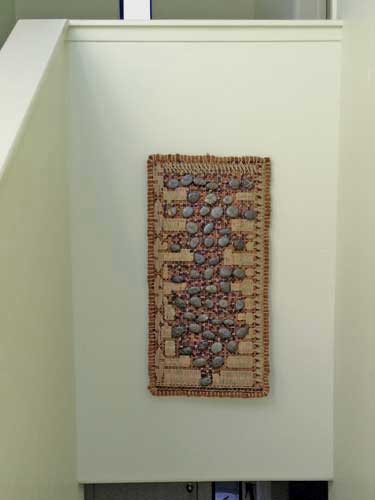
Yesterday I hung Sticks and Stones, but immediately realized two things: the piece is far too small for the space, and the lower right corner tends to bow out a bit.

Sticks and Stones

It is nice having something in that space. Need to start planning a larger piece.

How to fix the bow?

The piece is constructed of two pieces of hardware cloth bound together.

Sticks and Stones Back

Sticks and Stones Front

Bending should be an easy fix for the bowed out corner, but when I gave it a go, it did not change how it hung.

It really should be bent a bit toward the center, but I do not want to risk breaking the sticks that make up the code.

Sticks and Stones Code Detail

The plan is to let it hang until I figure out the bow problem.


Slat Book Progress…

I have been planning to make a slat book using the middle bit (ovary) from Pandorea jasminoides seed pods. I planned the code, “accustomed to being invisible” that will be stitched onto the plant bits.

Invisible Code

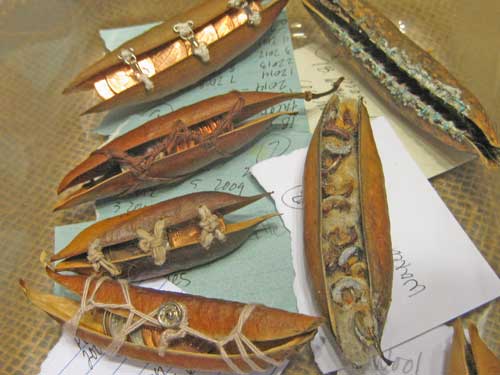
Holes in Pandorea jasminoides

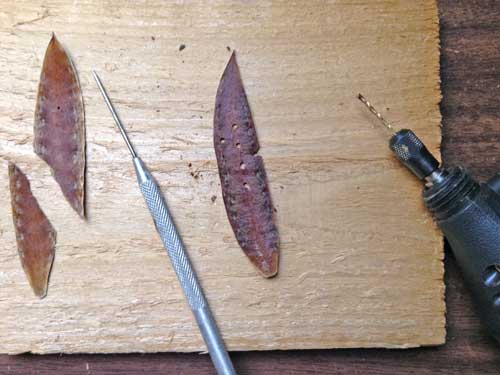
I used a needle tool to make holes in one piece. The piece fractured in half.
I then used a Dremel to drill holes. When I started stitching, with nettle, part of the edge broke away.


This is what the nettle twine looks like with the Pandorea jasminoides bits.
Nettle


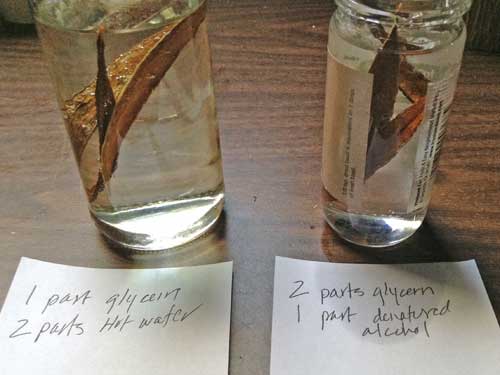
I decided to give glycerin a go to soften the pieces and to make them able to take the stitching. I am trying to solutions–one with hot water and one with denatured alcohol.

Tadpole

The jar on the left is a solution of 1 part gylcerin and 2 parts hot water.
The jar on the right is a solution of 2 parts glycerin and 1 part denatured alcohol.

It is interesting that many processes do require waiting. Sometimes a process can be sped up, most of the time patience is required.


Slat Book in Progress

I snagged some Pandorea jasminoides seed pods from a friend’s garden. They are woody and beautiful.

Pods

Open Pod

Open Pod Exposing Seeds

Pod Interior

Pod, Seeds Removed, With Interior Part


The pods have been used in my Change series.

Change Series


I kept the interior bits and seeds for possible future use.

Interior Bits

Seeds

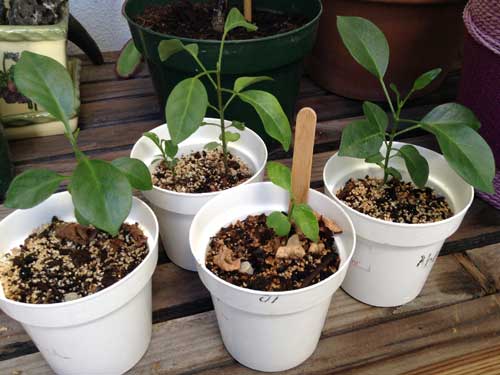
Curious if the seeds were viable, so I planted a few–

Seedlings


I kept thinking about the interior bits. How could I use them? Recently ran across reference to slat books in one of my sketch books.

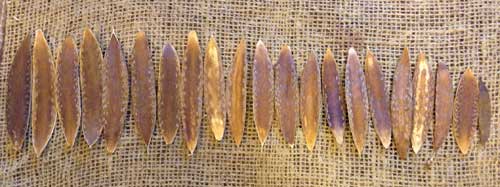
So, I selected the bits with the most interesting light lines.

Parts


The plan is to stitch a letter on each bit, then stitch them together. I had thought about using Ogham or A-tom-tom code, but for various reasons they didn’t feel right. Instead I made a stitch pattern based on Morse code. I actually made three versions. This is the phrase: Long forgotten memory.

Code for Long Forgotten Memory

For the slat book, I am deciding between the phrases, link with the past and accustomed to being invisible. Probably will use bamboo cord or Egyptian cotton thread for the stitch work.


When I quickly searched for the two types of code that I decided not use, I realized that both times I hit Omniglot, the online encyclopedia of writing systems and languages. It is a great site with loads of information.


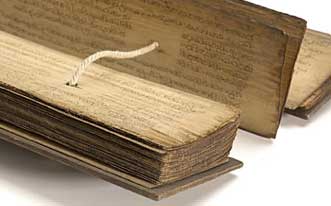
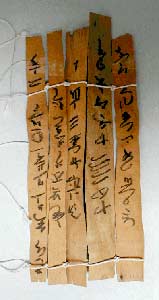
Strip or Slat books were made of a variety of material–bamboo, bark, and palm leaves. The material was cut into slats. The slats were either bound together or holes were made and cord was threaded through binding the slats together.

Information about the history of books and slat books can be found on the
Harry Ransom Center, The University of Texas at Austin website.

Slat Book


Information on Horizontal and Vertical Writing in East Asian Scripts can be found on Wikipedia.

Writing in vertical columns from right to left facilitated writing with a brush in the right hand while continually unrolling the sheet of paper or scroll with the left.


A brief description about slat books and a nice image can be found on Susan Kapuscinski Gaylord’s website makingbooks.com.

Slat Book


Information on early Chinese inscriptions can be found on Jeremy Norman’s website historyofinformation.com.


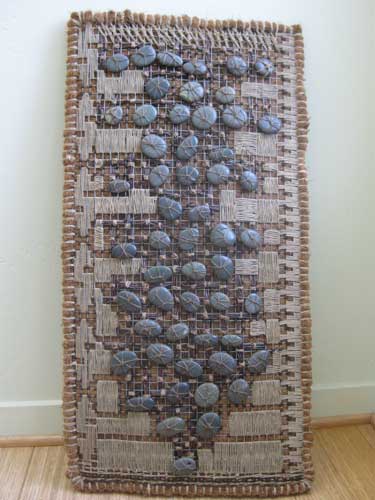
Sticks and Stones Finally Done

I spent several months deciding how to complete this piece. Attempted several borders, finally decided to make a coco fiber border. Coco fiber is pretty, but it is sharp and prickly.

Text

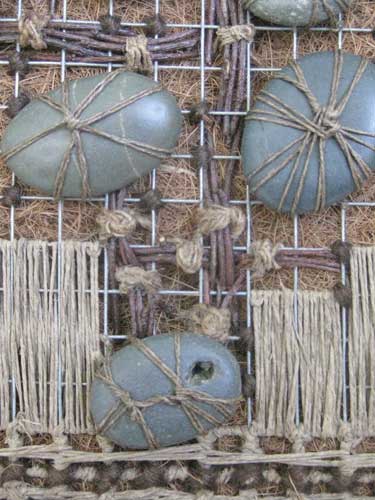
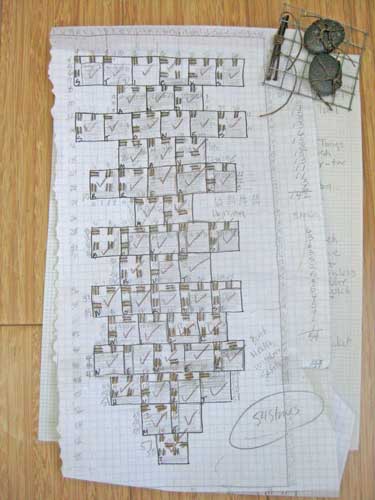
The piece has bundles of bound twigs used in place of Morse Code. The dots are bound to the hardware cloth vertically, and the dashes are bound horizontally. Each 4×4 square block represents one letter. And each block has a stone.

The message in the piece is: Sticks and stones may break my bones but words will never hurt me?

Yep, it does have a question mark in the code.

Sketch

The piece has two layers of hardware cloth and a layer of coco fiber between.

I have included an image of the back of the piece. Even though the back can’t be seen, it still exists. Also the back piece of hardware cloth has ready made hangers.

Text

Detail of sketch showing the code and a detail of the front of the piece.

Sketch Detail

Front Detail

The finished piece is 32.5″ x 16.75″ x 2″.
Materials List: hardware cloth, stones, coco fiber, cotton fabric, wool, hemp, stones, and starch.

I am seriously considering including the materials and code layout in a small cotton pouch attached to the back for easy access.

As for signing the piece, I will use some type of stitch work. Here are some examples of previous signatures.
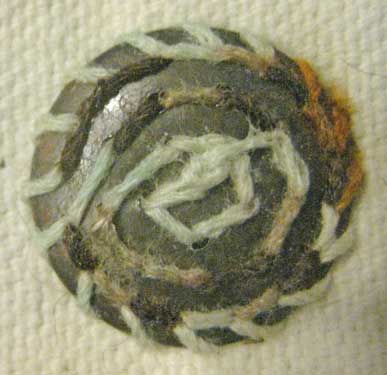
Signature

I have also used stitched perforated discs. The code starts from the left and spirals in. The code is in brown and tan. The rest is spacers and fillers.
Signature

They are rather nice because they are about the size of a quarter. There are a few patterns that can be used. This attempt was to be a bit willy nilly.

Back to Sticks and Stones–I need to sign it and hang it.

Miscellaneous information–the twigs are from a birch tree. Some believe that birch represents health, wisdom, and safety.

I select materials for what they bring to the work visually, but also culturally. Sometimes a material is selected because it has a connection to my personal history.

Does anyone need to know that when viewing the work? Probably not. Will knowing all of my reasons for making a work and selecting materials change how a work is viewed? Maybe…


Don’t Piece in Progress

I started the Don’t piece after watching Blink one of my favorite episodes of Doctor Who. The episode introduces the Weeping Angels, sculpture that isn’t really sculpture. When you blink or look away the Weeping Angels move. When they move they are dangerous.

In the episode Weeping Angels also known as the Lonely Assasins are explained:

“You die in the past, and in the present, they consume the energy of all of the days you might have had-and your stolen moments. They live off potential energy.”

What if you approached viewing art in the same way? Well, not with the fear that you might be sent back in time to die, but to really look. To see what is there, you must look. Not give the art work a passing glance, but really look at it. What about being a version of the Weeping Angels by snagging some of the energy put into the work by the artist…

I started a piece that has coded into it, “Don’t turn your back, Don’t look away, Don’t blink” some of the warnings in the episode.

Dont

I used color for the dots and dashes of Morse Code–rust yarn for dots, gray for dashes, and cream for spacers.

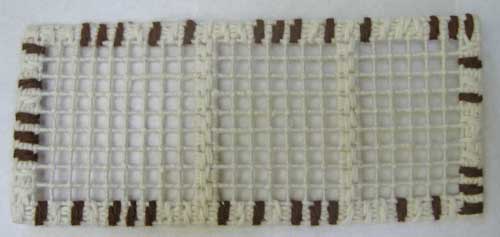
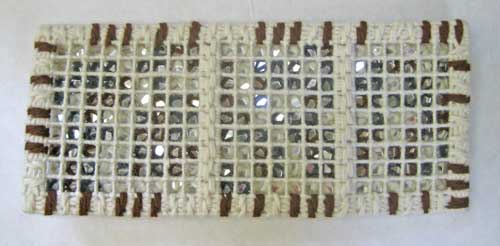
I cut the squares of mirror in half because after wrapping the hardware cloth with cream wool they were too large. And I like the idea of sharp edges.

Dont Code Detail

The frame will be bound to the coded piece. Actually the frame has code as well. The frame has the repeated word, see.

Dont Frame

The plan is to age and wax the coded piece and the frame. Then bind the two pieces together and the binding.

Dont With Frame


Palm Nuts Work In Progress

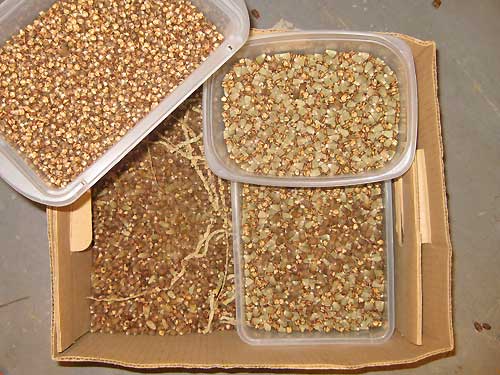
I have a great stash of palm nuts. Different sizes and colors. I was wondering what to do with them. Kept looking at them. Touching them. They are such beautiful little bits of nature.

Containers of Palm Nuts

Sunday I drilled holes vertically through the nuts, inserted wire. I bound four together to make a frame.

Palm Nuts Frame

Even if I used patina on the brass wire, I still don’t think I will like wire with the palm nuts.

I stitched a 9×9 using brown Egyptian cotton. The thread is barely noticeable, but when it is, looks natural.

Palm Nuts 9 x 9 Mat

Last night I drilled holes in 240 nuts. I need 218, but always make extra just in case. Tonight I will begin stitching them together with the Egyptian cotton.

Palm Nuts and Egyptian Cotton

There will be 99 connected little frames with a mirror in the center of each frame. Yep, I am making a grid using palm nuts.

I am not sure if the cotton thread will be strong enough to support the weight of 218 palm nuts and 99 pieces of mirror. I will address that problem if it becomes an issue.

Of course there will be a coded message. This time the message will be: another mirror held up to me.